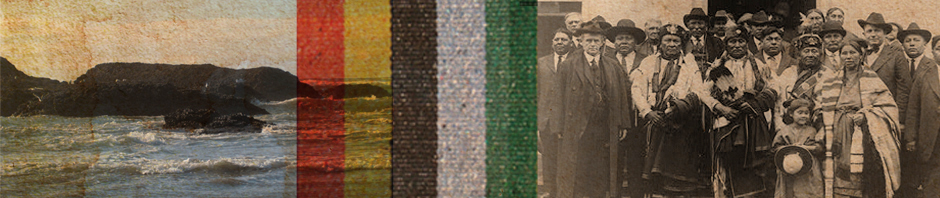

Four Osage sisters create the heartbeat of the new film, Killers of the Flower Moon (2023), which is based on David Grann’s 2017 book about the murders of tribal members in the early 20th century. Pictured, from left, are Rita, Anna, Mollie and Minnie. (Credit: The Osage National Museum/Doubleday. Date missing).
9 October 2023
The second week of October welcomes National Indigenous Peoples Day, which President Joe Biden proclaimed in 2021.
And while the country continues to attend to Columbus Day as a federal holiday (closing banks and the Post Office) individual states ˗˗ including my home-state of Oregon ˗˗ observe Indigenous Peoples Day.
That is, the Oregon legislature agreed to replace Columbus Day with Indigenous Peoples Day.
I like to observe Indigenous Peoples Day by first honoring it, and second, by sharing stories about my family—the Osage and Sioux side—and my scholarly work on Native American communities to help increase awareness of Native ways of knowing.
October also marks the US premier of a new film, Killers of the Flower Moon, which tells the story about murders of Osage citizens in the 1920s, described as “The Reign of Terror.”
My grandmother, who was born in 1904, was among my relatives in Oklahoma who lived through the trauma.
I will share my thoughts about the uprooting of people from a more global perspective, and then focus on the Osages.
I end with why I believe Truth and Acknowledgment are important first steps in reconciliation with Native peoples.
PART 1
Deracination
It takes imagination—and guts—to envision you are part of community that is overtaken by outsiders or displaced by insiders.
I think about it. A lot.
What is life like, if you or your forebears are Palestinian, African, Russian, Brazilian, Armenian, Tibetan, and (or) Indigenous North American?
Displacement carries a harsh pronouncement: it refers to “deracination,” which is Latin for uproot (not for “race,” although it sounds like it).
POLAND
With Indigenous Peoples Day inked on the calendar the second week of October, I try to imagine how residents of—for example—Poland felt in 1939 when Germany invaded.
Poles—whether Jewish or non-Jewish—were considered by the Nazis as “racially inferior.”
“Germans shot thousands of teachers, priests, and other intellectuals in mass killings,” according to the Holocaust Encyclopedia.
Nazis “sent thousands more to the newly built Auschwitz” and other prison camps in Germany, “where non-Jewish Poles constituted the majority of inmates until March 1942.
“Hitler intended to ‘Germanize’ Poland by replacing the Polish population with German colonists,” the encyclopedia says.
INDONESIA
Imagine you are Native to Indonesia when the Dutch arrive in the 1800s to claim Java as their own.
The Dutch required Indonesians to turn over profits from their crops to the new overlords.
Soon, nearly 20 percent of Holland’s national income came from Java.
Rice, corn, peanuts, sugarcane, coffee, sweet potatoes, cassava, sesame and more helped fuel the Dutch colonial appetite.

George Catlin (1796-1872) finished a painting titled “Three Osage Braves” in 1841. Unlike many painters of the time, Catlin personally encountered the Osages, whom he described as, “the tallest race of men in North America.”
PART 2
The Wah-Zha-Zhe
My Osage (Wah-Zha-Zhe) ancestors share a part of history with many Native peoples of North America who tried to ignore, reason, barter and kill invaders.
Turns out Thomas Jefferson envisioned a plan appeasing to the settlers while disastrous for Native communities.
Jefferson devised a scheme to pay Napoleon for French holdings in the United States, and he informed tribes that they (Indians) would occupy all lands west of Louisiana once the deal was brokered in 1803.
Osage ancestral homelands include parts of Louisiana and other territories, both east and west—and we sent delegations of our people to meet with Jefferson in 1804 and in 1806 in an effort to iron out details of the acquisition.
Jefferson promised that—if the Native people agreed—we would have complete ownership of territories west of Louisiana.
But the promise was never kept.
Foot by foot and mile by mile, invaders staked out lands further and further west, creeping through areas promised to—and occupied by—Native people.
By the time Missouri received statehood after the purchase, in 1821, some 5,000 Osages faced deracination.
Osages and other tribal peoples were attacked by settlers as we were prodded and pushed in myriad directions: from Missouri to Arkansas and then Oklahoma, and then to Kansas.
POST-SCRIPT: LAURA INGALLS WILDER
The beloved author of the Little House on the Prairie books—Laura Ingalls Wilder—would later learn her parents were among the invaders who built homes on Osage land in Kansas.
Laura McLemore, an expert on Wilder’s books, notes that the Ingalls family was “part of an illegal rush of settlers into the Osage” reserve in the late 1860s.
“Few people today realize, and perhaps Laura herself didn’t know, that a section of Kansas was once called Indian Territory” in reference to Jefferson’s political machinations, McLemore notes.
McLemore writes that, “in the early pages [of Little House on the Prairie] Laura quotes Pa as saying that animals wandered ‘in a pasture that stretched much farther than a man could see, and there were no settlers. Only Indians lived there.’
“Pa chose to ignore the fact that the land and everything on it belonged to the Osage people.
“He freely cut logs to build a house, hunted wild game for food and furs, dug a well and broke the land for farming,” McLemore writes.
Skirmishes between the Osage and homesteaders like the Ingalls forced my ancestors to find another home.
David Grann notes in Killers of the Flower Moon that Osages decided to purchase acres of inhospitable land in Oklahoma to the South, figuring the territory so desolate they would finally be left in peace.
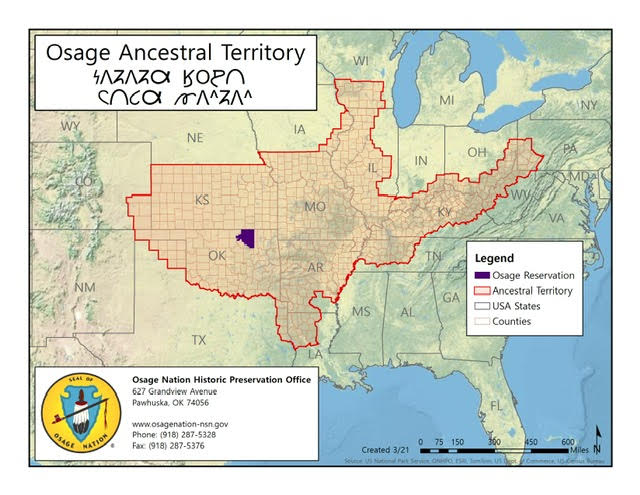
Map of traditional Osage lands and the current reservation. Courtesy of the Osage Nation
BACK TO OKLAHOMA
The 1871 “expulsion” to Oklahoma “was worse in terms of lives lost and hardships” according to Osage scholar Louis F. Burns.
“This move almost destroyed the Osage people. Old tombstones indicate the greatest toll was among young mothers and infants.
“Yet the old people who made the move never spoke of the deaths and sorrows,” Burns notes.
As part of their agreement with the US, the Osages negotiated to “maintain all the subsurface rights, mineral rights to our land.”
The agreement would prove serendipitous once oil was discovered at the turn of the century.
PART 3
Oil Discovered
Still, it would take several years to harness crude oil production, which required serviceable roads, vehicles, digging, drilling and rigging.
Meantime, Osages were “counted” as being enrolled by the US government until July 1907, when the tally of citizens was officially designated.
The list of more than 2,200 Osages included my grandmother (and siblings) and her mother—and each received a headright that resulted in payments from oil and other income-generating sources.
Such payments would label the Osages the richest people, per capita, in the world.
Burns writes the newly acquired wealth “attracted money-hungry outsiders” who found the means to inherit a headright [a practice now outlawed] by using grisly ways to murder Osages.
“The so-called Reign of Terror, in which a number of Osages were murdered for their petroleum wealth, ended only when the newly formed Federal Bureau of Investigation (FBI) won a conviction in federal courts,” Burns writes.

Osage-Sioux writer Fred Grove, who has written about the murders. Uncredited photo from the Arizona Daily Star.
SCORSESE’S FILM DEBUTS
Martin Scorsese’s new film—which opens in US theatres beginning October 20—was called, “a roaring crime saga about the murders that plagued the tribal nation starting in the 1920s, as the Osage’s neighbors and family members set out to strip them, by any means necessary, of their oil rights,” according to Melena Ryzik of the New York Times.
One of the Times‘ leading critics, Manohla Dargis, attended the film’s premier in Cannes, and called it, “shocking, at times crushingly sorrowful, a true-crime mystery that in its bone-chilling details can make it feel closer to a horror movie.”
The Reign of Terror has been long buried by many families but not forgotten.
My grandmother refused to talk about “the times” because “it is too painful.”
The film exposes a contradiction, in that the stories about the murders were closely guarded at home, and yet, several writers—including two of my relatives—hoped to write their views on the Reign of Terror.
Fred Grove, an award-winning author and my grandmother’s kid brother, was a youngster when he heard a late-night blast that shook their house which turned out to be a bomb that blew up a home where Rita Smith, Mollie’s sister, lived (pictured above).
Uncle Fred told a reporter that, the next morning, his mother, “told me not to go over there, but I sneaked off, and was sorry I did…There were pieces of flesh all over, and the house was just a pile of sticks. That stuck with me.”
Fred would later write a manuscript with the FBI official who investigated the murders, Tom White.
But the book was rejected, and Fred instead published a fictionalized version of the Reign of Terror in, The Years of Fear, his favorite book.
“This is close to my beginnings as a writer….my feelings, my heart.”
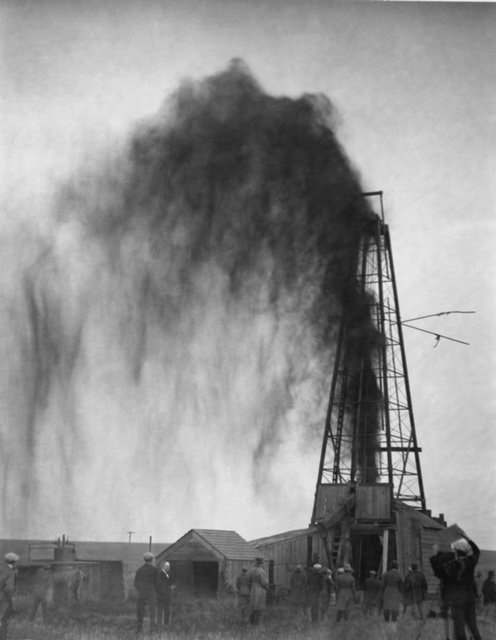
An uncredited image of an oil well from the 1920s in Osage territory. Source: Website “Famous Trials.”
NOTABLE CONTRADICTIONS WOVEN TOGETHER
The stories of the Osage murders bring into focus contradictions of ethics, ways-of-knowing, and how we remember history.
As Louis F. Burns noted in writing about the Osage removal in the 1800s to Oklahoma territory, “the old people who made the move never spoke of the deaths and sorrows.”
I have felt the conflict personally and professionally.
As a writer with a doctorate in journalism, I learned that good narrators advocate for unabridged sharing of information and truth-telling.
Yet, the more I learn about Indigenous aspects of story-telling, the more I feel conflict between Native ways and journalistic ways.
In Native communities, I have learned not all stories need to be shared.
Ethics are woven through our observances and practices, some of which are cloistered.
For example, we ask permission from our elders to share stories and songs.
Visitors are forbidden from taking photographs of ceremonial events, such as the In’Lon’Schka annual dances.
We revere ceremonial clothing and are distressed when our dress is mocked (as Halloween costumes) and when customs are appropriated as part of sports teams mascots and cartoons.
PART 4
The Value of Truth and Acknowledgment
Native American Day invites us to greet the day through the lens of Indigenous peoples.
I offer two ideas to help imagine the world through the lens, which, as I noted earlier, is threaded with ethics.
The first is Truth.
While all cultures honor truthfulness, Native North Americans have suffered disproportionate harm from lies, assumptions and “alternative facts” over land swindles, forced schooling, geographical isolation, sterilizations and murder.
And that means clearing away the historical camouflage that shrouds Indigeneity.
A national project has been launched called Reclaiming Native Truth, which encourages support of narratives about American Indians from American Indians “to foster cultural, social and policy change by empowering Native Americans to counter discrimination, invisibility and the dominant narratives that limit Native opportunity, access to justice, health and self-determination.”
The project urges folks to deconstruct time-worn narratives that dominate our social fabric by bringing into view perspectives from Indigenous peoples, rather than perspectives about Indigenous peoples.
One small truth takes us full circle to the beginning of this essay—Indigenous Peoples Day—in light of seeing Columbus Day through a Native gaze.
It is worth taking time to remember that North Americans already existed before Columbus mistakenly believed he landed in Asia in a territory he later called “The Indies.”
And myths of a free, virgin, vast and uninhabited land continue to underpin much of the falsehoods about the West and Native Americans.
Which brings us to the second notion: Acknowledgement.
I have learned that truth and acknowledging truth are fundamentally ethical ways of thinking and acting.
This observation crystallized while I was finishing a book about American Indians, Western science, the environment and mass media.
During this time I was also studying Zen Buddhism with the goal of becoming—formally—a Buddhist.
The framework of Indigenous ethics (inspired by writings from scholar Vine Deloria Jr.), which is foundational to my book, connects seamlessly with Zen teachings.
For example, Buddhists embrace an ethical life by contemplating the noble Eightfold Path, which includes truth and acknowledgment, through wise (“correct” or “right”) understanding, thought, speech, action, livelihood, effort, mindfulness and concentration.
I put this into practice when I travel—whether for work or pleasure.
For example, we spent a few days this summer hiking and swimming while visiting the city of Mt. Shasta in Northern California, a community of about 3,200 folks.
I learned Indigenous peoples lived in the region since—as they say—“time immemorial,” meaning, no one can remember when humans first walked here.
Turns out the name “Shasta” reflects the Native name of the Shasta (or Sastice) peoples, who occupied the area along with Modoc, Ajumani-Atsuwgi, Karuk, Wintu and other Indigenous peoples.
Learning about the Indigenous inhabitants of a region is an important part of my practice of Truth.
As for Acknowledgement, I share what I learn on my journeys by writing essays for my blog, posting photographs on social media, writing letters and postcards to family and friends, and sandwiching in a bit of history about a place in everyday conversations.
If I am speaking to a group or gathering, I first acknowledge the Indigenous communities that are Native to the region before introducing myself.
For me, Truth and Acknowledgement are actions—not just words—that are crucial to living an ethical life.

###
I honor the Native Peoples on whose ancestral homelands we gather here in the Pacific Northwest.
In concert with the premier of the film, Killers of the Flower Moon, the Osage Nation has released a short video, “Wah-Zha-Zhe Always.”
#Buddhism
#Davidgrann
#Deracination
#Eightfoldpath
#Framing
#Fredgrove
#Indigenouspeoplesday
#Indigenouswaysofknowing
#Killersoftheflowermoon
#Kiyuska
#Lakota
#Landacknowledgement
#Louisianapurchase
#Martinscorsese
#Mtshasta
#NativeAmericanHeritageMonth
#nativepress
#nativescience
#nativewaysofknowing
#nativewriter
#Osage
#Osagemurders
#Osagenation
#Reignofterror
#sioux
#Truth
#Truthandreconciliation
#Vinedeloria
#Wahshashe
#WahZhaZhe
#WahZhaZhealways
#Whatstrending


 Cynthia (Ištá Tȟó Tȟó) Coleman Emery's Blog
Well written thankyou.
LikeLike
Very thoughtful and thought-provoking. I read the book @ a year ago, glad I did. I learned from your post that the elders must give permission to share stories. Very interesting.
LikeLiked by 1 person
The book sits on a shelf as I could not bear to read it. Anyway, a deeply appreciated post. Also hard to read. Given the current world climate (literally and figuratively) move displacement is inevitable and the lack of kindness bodes ill.
LikeLiked by 2 people