New Documentary Asks What Happens When American Universities Respond to the Conflict in Israel and Palestine

8 September 2024

My friend Jan Haaken—a professor of psychology and a filmmaker—is steeped in a fund-raising campaign to clear $25,000 and finish a documentary about how faculty, students, staff and college communities in the US cope with speech freedoms, academic integrity, and protests surrounding current skirmishes in Israel and Palestinian territory.

The image has been attributed to street artist Banksy, although this could not be confirmed. A reverse-image search found the image on the Palestine Poster Project labelled as “Playground Gaza – Banksy,” dated 2023. The Project website says the image was sent by Ahmed Alnaouq from his X account, which identifies him as a Palestine journalist living in London.

Dr. Haaken says the question she gets asked most often isn’t what (what is the film about?) but, rather, when: when can we see the documentary?

While she, her co-director Jennifer Ruth, and her nine-member team are editing the final film, a website teases viewers with a trailer, details of the documentary, bios of featured commentators, resources for educators, questions for the team, and, naturally, a link to donate to the production.

Once completed, the film will make its rounds at venues across North America and beyond.

With nine feature films and five short films under her belt, Dr. Haaken’s latest inquiry examines how media coverage, internal campus responses and communication across college campuses have been framed following Hamas‘ 7 October 2023 attack on the Israeli side of the border with Gaza.

Gaza—a strip of land once controlled by Egypt—is now claimed by Palestinian refugees and is considered the most densely populated territory on earth: just 141 square miles altogether: the size of the city of Philadelphia but with a population of Philadelphia and Portland (Oregon) combined.

Map from the BBC, 11 October 2023

Thousands Die, Thousands Left Homeless

Turns out protests, vigils and public gatherings began worldwide hours after the attack by Hamas—a group the US considers a terrorist organization. 

Some 1,195 people were killed in Israel on 7 October, according to Agence France-Presse: about 69 percent were civilians. 

Israel responded swiftly and blocked access to “food, water and medical supplies,” notes Human Rights Watch

“Israeli forces began an intense aerial bombardment and later a ground incursion,” which continues as the blog is being written.

“More than 37,900 Palestinians, most of them civilians, were killed between October 7  (2023) and July 1, according to the Ministry of Health in Gaza. 

The Palestinian death toll for the first 10 months of the conflict is about the population of the city of San Gabriel in California.

“Israeli forces have reduced large parts of Gaza to rubble and left the vast majority of Gaza’s population displaced and in harm’s way.”

Vigils & Protests Ensue

Harvard’s Kennedy School tracked 470 public events in the US in the ten days following the first attack: 270 in support of Israel and 200 pro-Palestinian. 

Using a conservative counting method, crowd sizes topped 180,000 during the period.

Reactions to such events led Dr. Haaken and her team to interview a host of scholars, teachers and students.

For example, the film’s trailer features comments from Premilla Nadasen, a professor of history at Columbia University’s Barnard College.

“What we’ve seen in the past couple of months is a whole series of strategies universities have deployed to censor student and faculty speech in an attempt to curtail academic freedom,” Dr. Nadasen notes.

Columbia was among the first campuses spotlighted for its protests and for the ensuing administrative responses, including arrests by protestors, and charges of “no-confidence” for Columbia’s president by faculty members.

In April, six months after Hamas’ attacks, about 100 students were arrested in pro-Palestinian protests, and Columbia’s president, Nemat (Minouche) Shafik, was skewered by the press and called to answer questions before the US Congress.

In hindsight, it seems Dr. Shafik was ill-prepared for the barrage of insults from multiple sides: students, faculty, Jewish organizations, Palestinian communities, right-wing press, left-wing press, and even members of Congress.

Columbia’s president had served for a little over a year before she resigned last month (16 August 2024), just before fall classes began.


Photographer Tyrone Turner captures protestors taking a break for evening prayer during their demonstrations at George Washington University in the spring. Source: NPR (National Public Radio), 27 April 2024. 

The Palestinian Exception

Dr. Shafik’s brief tenure illuminates the tensions surrounding censorship and the discourse of what has been called The Palestinian Exception—the name of Dr. Haaken’s documentary and the nomenclature used when writers command a stance that analyzes Israeli actions critically. 

That is: condemnation against Israel is reframed as antisemitic, thus shutting down the critic. 

Palestinian exceptionalism harkens back to comments made a decade ago by the late Michael Ratner, a civil rights attorney and activist, who critiqued cultural norms providing that the interpretation of American free speech fails to encompass criticisms of Israel, thus creating “The Palestinian Exception to Free Speech” or to the First Amendment.

The gauntlet has been gripped by many who argue that freedoms encompassing speech, teaching and research should never pivot on what politicians decide as normative.

The most trenchant example of such exceptionalism is seen in the grilling by Representative Elise Stefanik (R, New York) of presidents from Harvard, MIT and the University of Pennsylvania at Congressional hearings in December 2023.

Stefanik accused the trio—all women—for failing to label campus protests as antisemitic

More than one critic has compared The Palestinian Exception with Senator Joe McCarthy’s persecution of Americans in the wake of the Red Scare’s fear-mongering of communism in the 1950s.

“McCarthy rose to national prominence by initiating a probe to ferret out communists holding prominent positions. During his investigations, safeguards promised by the Constitution were trampled,” according to the US History.org website

Like McCarthy, Stefanik took credit for upending careers of elites: the three presidents resigned their posts after Stefanik lobbied dishonest, trumped-up claims to disparage the three women who held some of the Country’s most powerful positions as academic leaders.

Currently Stefanik has set her sights on the most powerful woman in New York—Governor Kathy Hochul—armed with a script from Joe McCarthy.

According to her website, Stefanik asked for an investigation a few days ago that accuses Houchel of hiring an aide who the Congresswoman calls a communist.

Fear of communism was tangible during McCarthy’s reign, which was characterized by “hysteria,” according to editors of the website History.com. 

“The advances of communism around the world convinced many US citizens that there was a real danger of ‘Reds’ taking over their own country. Figures such as McCarthy…fanned the flames of fear by wildly exaggerating that possibility.”

According to the ACLU (American Civil Liberties Union), “thousands lost their jobs, were imprisoned, faced organized mob violence or were forced to leave the country” during the Red Scare

Critics note that extra-terrestrials, aliens and Martians in science fiction films of the Mid-Century were a stand-in for communists, such as the 1956 feature, Invasion of the Body Snatchers, starring Dana Wynter and Kevin McCarthy. Photo credit: Getty Images.

Faculty and Journalists Fired 

As in McCarthy’s era, faculty and media experts have found themselves jobless today for their stance on justice and freedoms resulting in discourse over the war in Palestine and Israel.

  • Mohamed Abdou, a visiting professor in Middle Eastern, South Asian, and African studies at Columbia University, will not have his contract renewed in 2024. Intercept columnist Natasha Lennard says a Facebook post from October “was taken wildly out of context” and “has been weaponized to undo Dr. Abdou’s career, after 20 years of teaching in Canada, Egypt, and the U.S. in fields including queer studies and Indigenous studies.”
  • A scholar of Japanese literature at the City University of New York’s Hunter College, Lisa Hofmann-Kuroda, said a student reported her pro-Palestine social media posts to the head of her department. “Nothing in the posts…was antisemitic,” Dr. Hofmann-Kuroda told Lennard. “The only thing I have done,” she said, “is to criticize the state of Israel for its 75-year brutal occupation of Palestine and criticize Americans for their complicity or silence in this genocide.”

Journalists have also lost jobs for their stance on Israel and Palestine. 

  • Long-tenured cartoonist for The Guardian newspaper, Steve Bell, was told his contract would not be renewed after he complained on social media about the paper’s “decision not to run an illustration in which he depicted Netanyahu cutting a square of his stomach out with a scalpel in the shape of Gaza,” says Newsweek
  • The editor-in-chief of Artforum magazine—David Velasco—was fired after the magazine published an open letter signed by 8,000 individuals who condemned violence in the war. Velasco told The Guardian‘s Gloria Oladipo, that he has “no regrets. I’m disappointed that a magazine that has always stood for freedom of speech and the voices of artists has bent to outside pressure,” he said. 

How to Support the Documentary

You can make a donation of any amount—tax-deductible—at Film Independent.

I care deeply about academic freedom and free speech, and I support the documentary with all my heart (and with my checkbook, too).

You can watch read more about the film at the documentary’s website.

###

Next up: The connections between The Palestine Exception and freedoms of Native Americans.

I acknowledge the Native peoples on whose land I live, write, and teach, including the Multnomah, the Clackamas, and other Indigenous communities in my region of the Pacific Northwest.
Posted in aggression, alternative facts, censorship, communism, democracy, film, Gaza, journalism, nativescience, Palestinian, persuasion, press | Tagged , , , , , , , , , , , , , , , , , , , , , , , | 2 Comments

Labor Day

How Sioux history intersects with Labor Day

2 September 2024

I am reposting a bit of history about Labor Day to recognize workers who lost their lives before such a day was commemorated in their honor.

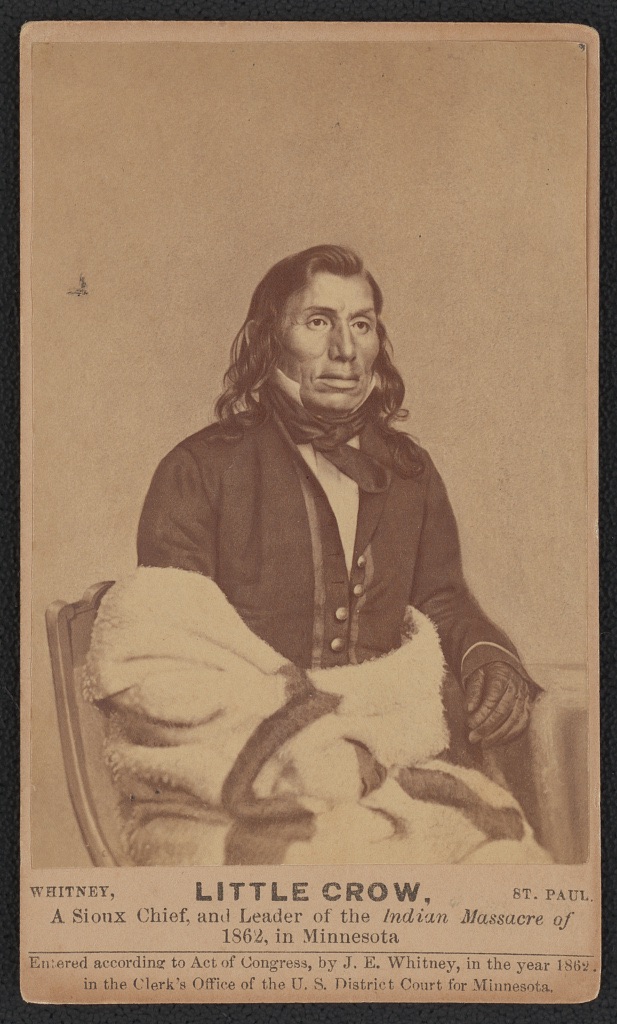
Today—2 September—marks not only Labor Day: it marks a memorable battle by the Santee Sioux in 1862.

The Santee fought soldiers in Minnesota following a summer of starvation when rations were withheld on their reservation. 

According to historians, “the Santee were badly mistreated by corrupt federal Indian agents and contractors.” 

Beginning in July, Indian agents “pushed the Native Americans to the brink of starvation by refusing to distribute stores of food because they had not yet received their customary kickback payments. The contractors callously ignored the Santee’s pleas for help.”

At Birch Coulee (near Morton, Minnesota), 13 American soldiers perished and 47 were wounded in the battle led by Little Crow.


Little Crow (Taoyateduta) led several of the skirmishes in the Minnesota raids in the 1860s. Photo credit: Joe Edmonds Whitney, photographer

Weeks later, the Native warriors were overcome by the military, and they surrendered on 23 September.

In the following months, some 300 Santee Sioux were tried by non-Indians and were sentenced to hang.

Although many were saved from the gallows through an act by President Abraham Lincoln, the remaining 38 “were hanged simultaneously on December 26 in a mass execution witnessed by a large crowd of Minnesotans.”

While the uprising of the Sioux seems unrelated to the history of Labor Day, many events leading up to the deaths of Native peoples, coal miners and garment workers were driven by greed: a desire by settlers and merchants for what was considered “virgin land” occupied by denizens considered undeserving of their own territory; a lust by industrialists for cheap coal extracted to fuel railroads and steel production; and the indifference by owners of the welfare of Jewish immigrants who sewed clothing in dark and crowded rooms for a few dollars per day.

Lewis W. Hine documented child labor conditions in the 1900s—traveling throughout the country and taking photos with his five-pound Graflex 4×5 camera. Historians credit Hine with creating the “photo story,” where images—rather than copy alone—capture a narrative. When visiting a mine in West Virginia in 1908, Hine snapped the picture (above) of a youngster who worked as a “driver” from 7 in the morning to 5:30 at night, seven days a week (Murrmann, 2015 October 3). Source: Library of Congress

Labor Day: What Does it Mean?

Reposted from September 2023

Labor Day gives me a chance to read up on American history and ponder what prompted policymakers to recognize workers on the first Monday of September some 129 years ago.

Declaring a special day in history, unfortunately, had no relationship with working conditions and no predictable change in the status quo.

No single event shined the political spotlight on laborers despite countless (and often needless) tragedies that struck workers in the U.S. before, during and after President Grover Cleveland declared a federal holiday called Labor Day in 1894.

One noteworthy event that focussed international attention on workers was an explosion that killed at least 362 miners—boys and men—in Monongah, West Virginia, in 1907: more than a decade after Labor Day was made official.

Some historians consider the conflagration “the worst mining disaster” in American history (Wishnia, 2021 December 3).

The Monongah Mine Disaster

Miners’ deaths worldwide were caused by a number of hazards—beginning more than a hundred years ago—and not only lung diseases and bone-breaking chiseling through rock—but a result of fires, blasts, blow-ups (caused by igniting dynamite and from gasses lit by coal dust), flame-cutting practices, and more.

In the case of the explosion at the mines in Monongah (a community named for the Native people who long lived there, and who reportedly perished once settlers arrived), a fire broke out, apparently starting when a coupling link broke on a train-load of coal cars leaving the mine (and carrying about 30 to 40 tons), sending the cars backward into the mine.

“The loose cars crashed into a wall, cutting electrical cables which then ignited the dust cloud which had been raised by the crash, it was firmly asserted, and this resulted in an explosion so vast and so powerful that it ruptured almost every ceiling and wall in the mine, instantly killing the miners working below,” according to World History.

Writer Steve Wishnia said the death toll is uncertain because the mining company—Fairmont Coal—hired many part-time workers “off the books” and rescuers (some who died during attempts to find miners) were unable to pull out all the bodies because breathing air in the mine was “too toxic.”

Wishnia noted that 1907 marks the worst year for mining deaths in the US.

Two weeks after the Monongah blast, an underground explosion at the Darr mine in Pennsylvania killed 239 boys and men—the largest mine disaster in the state’s history.  

By the end of the year, more than 700 laborers died from mining accidents.  

Owners balk over unions

Fairmont Coal Company was never held responsible for the Monongah mining tragedy, yet local folks started a relief fund to help families affected by the blast.

Andrew Carnegie, an industrialist with interests in—among other things, steel and coal—contributed a large sum of money through the Hero Fund, which he managed and is still in operation (in 2022 the fund awarded $40.5 million in aid.)

As the mining industry grew, workers in Appalachia formed unions to represent their interests with owners, who were notorious for paying low wages and ignoring the dangers of mining—from the sheer physicality required to free coal from rock—to the inevitable lung diseases arising from exposure to coal and silica dust, according to the Ohio History Central website.

Mining was considered “the most dangerous job on earth.”

At least two unions were formed in the late 19th Century, including the American Miners’ Association and the United Mine Workers of America.

Yet, the unions had little leverage in 1907—when the worst disasters occurred.

The noteworthy 1902 strike

Pennsylvania miners living about 100 miles north of Monongah went on strike five years before the deadly fire.

Anthracite coal workers in Eastern Pennsylvania—who mined the most cherished of coal—asked for shorter work days and better wages.

The walk-outs started in May and June in several communities, and lasted until October, 1902.

Some 147,000 workers contributed to the “Great Strike.”

As winter approached—and without the prospect of coal—schools, shops, transportation services and government offices across the country (and especially in the East) feared “untold misery” and “social war,” according to Scott Connelly.

President Theodore Roosevelt intervened behind the scenes: he was prevented from taking action.

Technically.

Instead, Roosevelt brokered meetings with workers, management and the government to resolve the conflict, and his actions helped end the strike.

Miners were given a 10 percent increase in wages (they asked for 20 percent) and were awarded a 9-hour workday (they asked for 8).

Political cartoons–regardless of the news’ political stance–credited President Teddy Roosevelt with intervening in the Anthracite Coal Strike of 1902.

Image (uncredited) from the website “ehistory” at Ohio State University

Remarks

Clearly establishing a national holiday to recognize workers offered little comfort or agency to laborers working in mines and factories in 1900s America.

Despite the Monongah mining disaster of 1907 and New York’s Triangle Shirtwaist Factory Fire in 1911, policymakers were molasses-slow in securing—not just workers’ rights—but human rights.  

It took decades to enact the Fair Labor Standards Act in 1938 to protect children.

Today, the US is stuck in a past riddled with ridiculous laws that unfairly thwart fair wages.

And while the federal government establishes a minimum wage, it hasn’t changed since 2009.

As of this writing, the US minimum federal wage set 14 years ago is still $7.25 per hour.

One pundit, who works in communication for the AFL-CIO (American Federation of Labor and Congress of Industrial Organizations) reported that in 2009, a Big Mac cost $3.58 in the US.

Today, a Big Mac costs $5.81: an increase of more than 63 percent (See @KalinaNewman, 2022 April 27).

Apartment rentals follow a similar trajectory, according to a national property management organization, which compared average rents, overall, in 2009, with 2021.

A typical rent in 2009 was $944 per month.

Rents rose 63% to $1491 per month in 2021, and continue to climb in 2023.

Cost of a first class stamp in 2009 was 44 cents.

Today you need 73 cents to mail a first-class stamp.

It’s worth noting that industries that sell beef, mayonnaise and toilet paper blame their mounting prices on inflation.

And they successfully lobby politicians.

“Members of Congress who receive an influx of money from corporations and trade associations are less likely to discuss things like wages or income inequality,” note two political scientists writing for The Hill.

“What’s more, members of Congress equate positive economic performance with the goals of business, while ignoring the needs of the ordinary workers and consumers who make our economy work,” they add.

Senator Phil Gramm (R-Texas) has argued in favor of placing business owners over workers, saying, “Wall Street is the foundation on which Main Street is built'” (Morgan & Wilco, 2021 July 20)

What a pity to see politicians’ priorities in play. ###

I acknowledge the Native peoples on whose land I live, write, and teach, including the Multnomah, the Clackamas, and other Indigenous communities in my region of the Pacific Northwest

#minimumwage

#laborday

#nativescience

#defenddemocracy

#whatstrending

#washashe

#osage

#nativescience

#indigenouswaysofknowing

Posted in american indian, labor day, minimum wage, nativescience, unions | Tagged , , | 2 Comments

Postcards of the Resistance

2 October 2025

Earlier this week I wrote about ouright lies and censorship advanced by leaders of the US government.

Some are breathtakingly absurd (such as the vice president’s claim that residents in his homestate of Ohio were eating the neighborhood cats and dogs.)

Other lies feed into the many falsehoods that have taken hold in popular culture of, for example, vaccines.

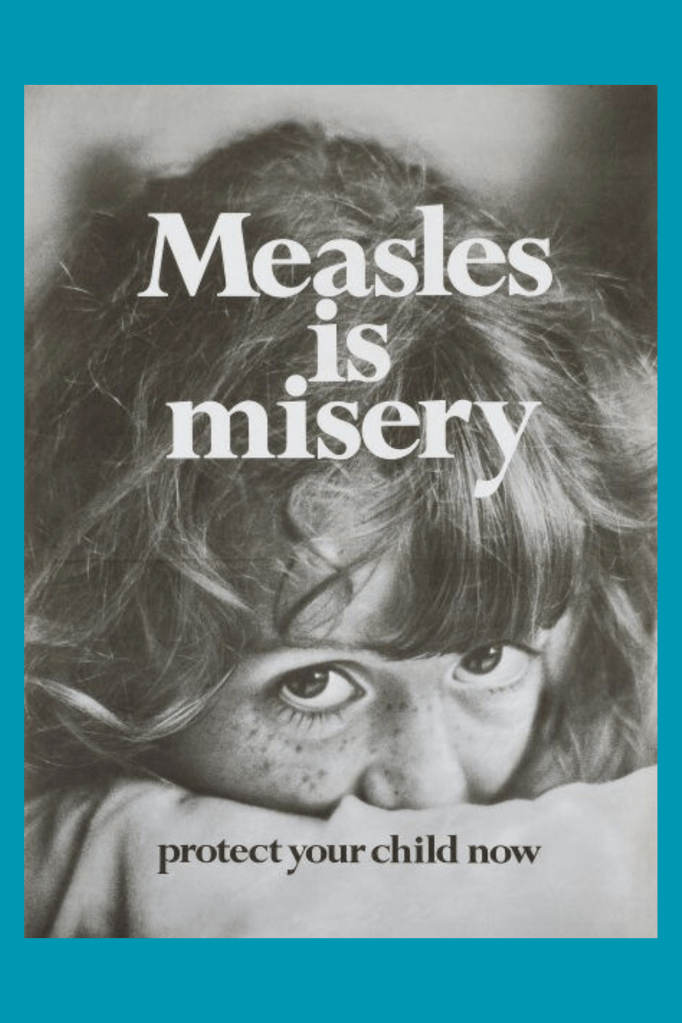
I created a postcard (above) with the aim of offering the science about the measles, mumps and rubella vaccine.

It is my contribution to The Resistance.

One notable lie came from the head of the country’s health and human services department who told reporters the MMR vaccine “contains a lot of aborted fetus debris and DNA particles,” according to Reuters.

Experts say the claim is false.

Truth is, the vaccine has saved “94 million lives” worldwide, according to the non-profit, Our World in Data.

To give you context, 94 million lives is about the population size of Canada and Kenya, combined.

Measles is a highly contagious virus that can cause pneumonia (one in 20 people), brain swelling (two in 500) and death (one in 1000).

This year, two children—who were not vaccinated—died from measles in Texas: the first US deaths since 2003, according to PBS.

More than 750 were sickened and 100 hospitalized in the Texas outbreak that spread to 37 countries.

The head of HHS has been so reckless in his remarks and actions that Congresswoman Haley Stevens of Michigan filed articles of impeachment against Robert F. Kennedy, Jr., on September 25.

In the postcard (above) I chose an image from a national vaccination campaign in Britain in 1985, and wrote the copy using sources such as the Centers for Disease Control and Prevention (CDC). 

I mail the postcard to my friends and carry them in my purse so I can post them on community bulletin boards.

Thanks for listening.

I am now posting the blog I began in 2010 on Substack.

See: https:\\cynthiacolemanemery.Substack.com

Posted in alternative facts, censorship, ethics, hate speech, nativescience | Tagged , , , , , | 1 Comment

Facts and Evidence Have No Purchase in Portlandia

Our city has been threatened by the felon-in-charge (Trump was found guilty on 34 unlawful acts) who declared Portland “war-ravaged,” according to today’s New York Times.

Our governor simply said: “Let’s not take the bait.”

Tina Kotek—a rational and just human being—is right.

Don’t take the bait.

Portlanders have been posting photos of peaceful protests and bucolic scenes on social media for days, in anticipation of lies shared by the president and his public relations hacks.

One thing is clear: facts and reality have little purchase among America’s leaders intent on stripping cities, like Portland, of its constitutional right to self govern.

How to Respond?

My social media pals have responded with humor and good taste, showing viewers the reality of Portland’s neighborhoods.

I have given myself the task of making cards that can be shared, uploaded and mailed that set straight some of the lies.

One card takes aim at censorship from the felon-in-charge. It reads:

“Imagine living in a country where certain words and phrases are forbidden, and where censors remove concepts such as slavery, sexism and racism from government websites, mission statements, monuments and more.

“You will now find lists of forbidden words in the United States, where an unAmerican tyrannical order is gaining traction by reframing history and, most troubling, reality.

“One example is the Civil War-era photograph of an escaped slave called Gordon, who posed for images that show his mutilated skin scarred from a savage whipping.

“Copies of the photos—which were circulated widely in the public arena at the time—were meant to curry favor for the abolishment of slavery.

“The National Portrait Gallery, the National Gallery of Art and the Fort Pulaski National Monument have copies of the photos that have been on display at various times and are now under ideological scrutiny by government workers charged with removing artifacts deemed unAmerican: a term now re-fashioned so tyrants can rewrite history and quash free speech and press freedoms of truth-seekers. For more see Ritchie Calvin, 13 February 2025, The Medium.”

The image is in the public domain:

28-29 September 2025

Posted in nativescience | Tagged , , , , , , , , | 1 Comment

Native American Heritage Month

Nanye’hi (pictured), a Cherokee leader, called for peace between the denizens and settlers. When the U.S. Supreme Court decided in 1832 that Georgia had no authority over the Cherokee, which was a sovereign nation, President Andrew Jackson ignored the ruling. Source: Tennessee State Museum website. Note: Photo could not be authenticated.

1 November 2024

Today feels fresh, just like when you turn the page of a paper calendar and greet a new month.

November in the United States marks a time to attend to Native history and a time to consider both present and future.

In my family, to mark the present, we give our grand-children Osage or Lakota nick-names and teach them Native words for the creatures in their picture books.

True, I have to look up most translations, and I am joyful to show the little ones a buffalo (Mahto: Lakota) a dog (Shokah: Osage) a spider (Ektomi: Lakota) or a raccoon (Meeka: Osage). 

I share little stories I’ve discovered of Native peoples who lived (or continue to live) where our grown children and grand-children now call home.

For example, when the cicadas creep from the earth to mate in certain summer cycles (in Chicago), I remind the little ones Indigenous folks found ways to eat the protein-rich bugs.

Blockprint of a cicada. C. Coleman Emery 2022

Today I start a visit to the American South, and recall what I learned many years ago when studying histories of Native peoples in Georgia, Tennessee, North Carolina and South Carolina.

The Cherokee are likely the folks best known in these parts. 

After settler contact, the Cherokee took purposeful steps to reframe outsiders’ perceptions that Indigenous individuals were lazy and illiterate.

Many adopted settler dress and built homes fashioned like log cabins, while others learned English and some were educated in Western schools.

In the early 1800s, Sequoyah, with shrewd insight, spent years developing a writing system for the Cherokee language. His final project is called a “syllabary” because each symbol he created represents a “syllable.” 

The written language spread and was introduced through mass media in 1825 with the first Native newspaper: The Cherokee Phoenix.

The Cherokee Phoenix was first published in 1825

Like many of the Cherokees’ countrymen and women—the Chickasaw, Creek, Choctaw, Seminole and so on—their soil, streams, wildlife, plant life and gold were coveted by settlers. 

The Cherokees’ plight found a sympathetic ear with the U.S. Supreme Court, which ruled in the tribe’s favor in 1832, thus restricting the settler government from seizing their lands in Georgia. 

Turns out the Cherokees’ attempts at “civilization” posed a threat to the narratives invented by settlers, whose desires were fueled by the popular—and false—notions that Indigenous people lacked the brain power to be educated, much less civilized.

The Supreme Court ruling in favor of the Cherokee was ignored by President Andrew Jackson and by his successor, Martin Van Buren, each who ordered troops in the 1830s into Southern states to wrench Indigenous denizens from their homes and force-march them more than five thousand miles to Oklahoma, according to the National Parks Service

I am reminded of this as we drive through Raleigh, Durham and Chapel Hill, home today to more than 130,000 Native Americans in North Carolina

I celebrate the month by honoring the past, present and future of denizens in today’s post, and I will send postcards to friends and families, reminding them of the denizens who called the regional home for––at least—14,000 years.

#americanhistory

#andrewjacksom

#cherokee

#indigenous

#latestnews

#nativeamerican

#nativeamericanheritage

#nativehistory

#streamingnow

#trailoftears

#trending

Posted in american indian, Cherokee, Indian relocation, James Chatters, national native american history month, nativescience | Tagged , | 2 Comments

Lies, Disinformation and Misinformation

LITTLE THEORIES

When Martians land (Credit: Noyes, from openart)

My blog brings together studies of science, culture, media and discourse with an emphasis on issues that impact Native Americans. Today I’m looking at deceptive tactics aimed at persuading you to believe stories that are lies.

I share some ways you can defend yourself against lies, disinformation and misinformation, courtesy of a famous study that sought to answer the question: Why did some residents of New Jersey believe Martians landed in Grovers Mill on 30 October 1938?

We can learn from research conducted 86 years ago that people use the same logic in making decisions—but the logic is often flawed.

When Lying is the Norm

Have we become inured to lying?

I expect some folks involved in politics will straight-out lie to any of us who listens. And there is bountiful proof that politicians lie.

But I want to believe other muggles share my values: that lying is dishonorable, and that speaking truth is virtuous.

Buddhist teachings ask followers to aspire to honesty.

Although we can’t be perfect, the idea that we try to lean into honesty is a worthwhile practice.

We are muggles, after all.

When Lies Cause Harm

A politician’s confession to lying recently—not only made headlines—it begs the question: Does lying matter?

Here’s a recap of the story du jour:

James Donald Bowman, or, James David Hamel, or, J.D. Vance, or JD Vance [no periods]—Trump’s 2024 running mate—told reporters peoples’ pets in his home-state of Ohio are being eaten by immigrants from Haiti.

According to NPR, Vance posted on social media’s X the following statement on Monday, 10 September 2024:

Reports now show that people have had their pets abducted and eaten by people who shouldn’t be in this country.

Trump repeated the lie the next day, during the national debate with Kamala Harris, which was watched by 67.1 million people, according to Nielsen Media Research.

For scale, that’s more than the populations of Australia, Chile and The Netherlands—combined.

Trump said:

” ‘In Springfield, they’re eating the dogs. The people that came in, they’re eating the cats,’ Trump said. ‘They’re eating the pets of the people that live there.’ “

CNN called the claim a lie, and added that the city’s mayor, the chief of police, and the governor of Ohio found no evidence—and no reports from Springfield residents—that anyone is eating pets.

Illustration of Pinocchio by Carlo Chiostri and A. Bongini, from “Le Avventure di Pinocchio, Storia di un Burattino,” 1902. Image is in the Public Domain.

Crooked Paths, Twisted Words

The lie is an example of disinformation, which media scholars define as a fabrication with a purpose, such as persuading publics that, for example, Barack Obama was not born in the US (his birth certificate—which he made publicly available—places his birth in 1961 in Hawaii), as claimed by Trump for many years.

Misinformation is not seen as an intent to deceive, and there may be no truth or some truth to the inference.

For example, scientists now know the best way to transmit COVID is person-to-person—through human aerosols that carry fine particles of the virus.

That’s why masks are effective at reducing your risks of infection.

In the early days of COVID advice, some experts suggested washing paper money and coins, wiping down conveyer belts in the grocery store, and avoiding hand-shakes.

Such recommendations could be considered misinformation, but cleaning coins and sponging surfaces cause no harm and can reduce the spread of some germs.

But misinformation and disinformation from the Republican nominees for president and vice-president have laid a path for harm.

With intent.

On the Sunday following the candidates’ debate, Vance appeared on CNN’s State of the Union and admitted he had lied: repeating over and over a rumor posted on social media that the person who started the lie renounced her claim of pet-eating because she had no evidence to support her words.

Vance admitted he repeated the tale to large audiences, knowing it was false.

Vance defended and normalized lying because he said he needed to, “Create stories so that the…media actually pays attention to the suffering of American people.”

Vance and Trump have since doubled-down on the lies, creating an environment for physical harm when their followers threatened to bomb schools, hospitals and government buildings in Springfield, the city targeted by the politicians.

After 33 bomb threats were made, the Ohio governor called in 36 state troopers to police classrooms for bombs, according to one news report.

The Background Story

For background, I turned to the New York Times, whose expert on immigration reported last week thousands of Haitians fled their country following several waves of political upheaval, including the murder of President Jovenel Moïse in July 2021.

In addition to the US, Haitians have emigrated “in large numbers for a long time to Brazil, Canada, Chile and Mexico,” Jordan notes.

Springfield actively recruited workers to the town by shoring up jobs and turning around its flailing economy.

The city created “thousands of jobs” some years ago, thanks to a “boom in manufacturing and warehouse jobs attracted a swelling wave of immigrants, mainly from Haiti.”

“By 2020, Springfield had lured food-service firms, logistics companies and a microchip maker, among others, creating an estimated 8,000 new jobs and optimism for the future.”

“City officials estimate that as many as 20,000 Haitians have arrived, most of them since the pandemic,” Jordan writes.

Pulitzer Prize-winning journalist, editor and publisher Garry Pierre-Pierre (who is Haitian-American) writes, “In the past, immigrants may have faced hostility but eventually they became part of the fabric of their new communities,” according to MSNBC on Friday 20 September.

Pierre-Pierre adds we’re witnessing division from “hateful rhetoric” voiced by extremists in Springfield and elsewhere.

“Instead of Integration,” Pierre-Pierre notes, talk and action are “designed to tear apart communities like Springfield.”

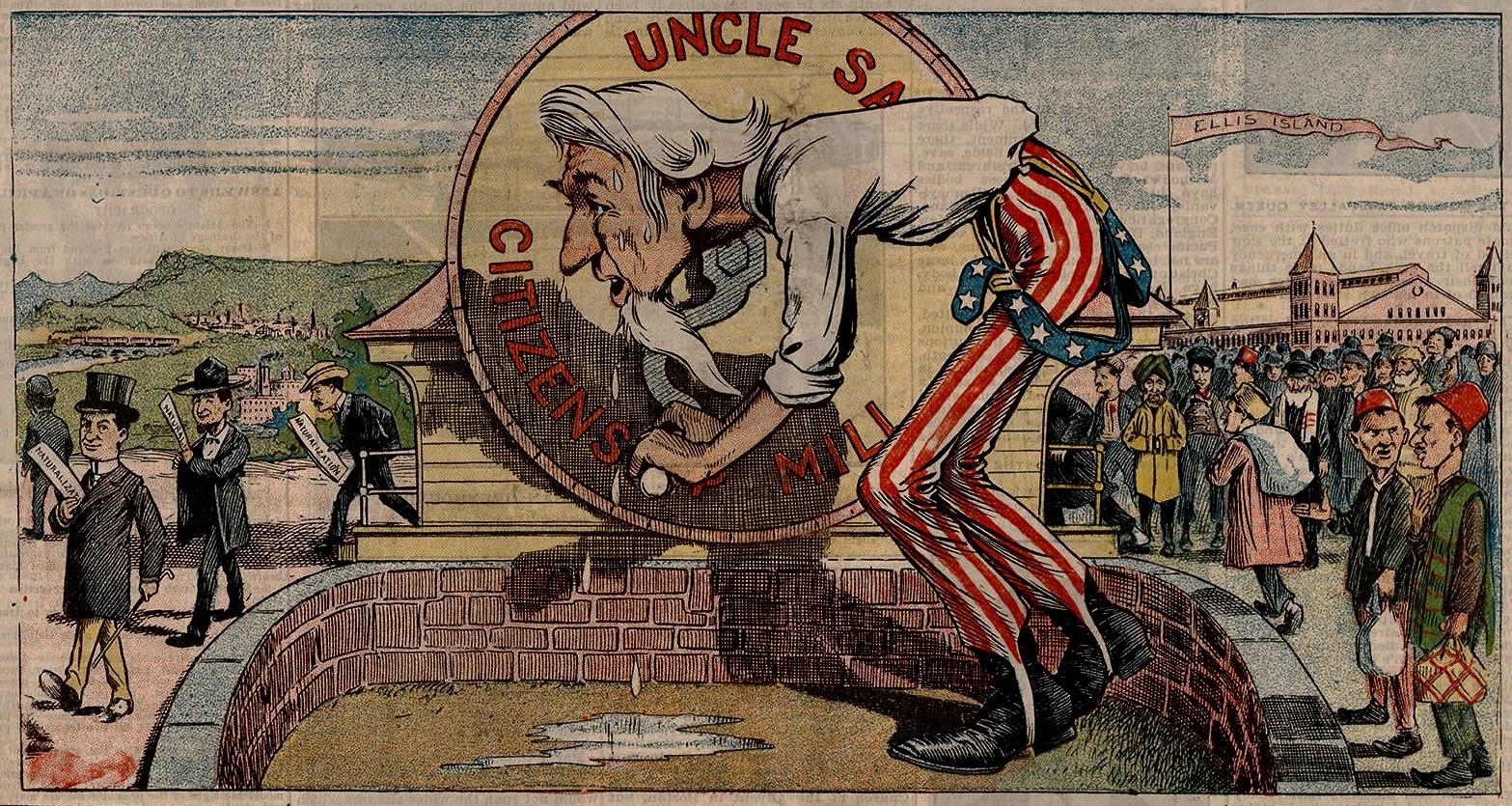
Strangers who landed in North America have long witnessed harassment by skeptic Native residents—from the arrival of settlers on the Eastern seaboard, to the Russian merchants landing on the Pacific Coast in search of fish and fur. Editorials—such as the cartoon from 1903—dramatized the agita of policy-makers, as shown in the cartoon titled, “Uncle Sam Perspires at his Growing Job: He finds turning the crank of the assimilation mill is taxing his strength to the utmost,” 1903. (Photo credit: Ohio University Billy Ireland Cartoon Library & Museum Art Database. Image in the Public Domain).

Preparing for the Onslaught

The looming presidential election brings countless opportunities for outright deception, in addition to endless stories of disinformation and misinformation.

Examples that have gained traction include voter fraud.

Yet, real-life instances of dead people and non-citizens actually voting illegally are minuscule, according to Chris’s Brennan, elections columnist for USA Today.

Brennan notes that when “officials from Arizona, Georgia, Michigan, North Carolina, Pennsylvania and Wisconsin” met recently, they say their “biggest concern” is “rampant disinformation” about the elections, which undermines how people feel about voting.

Americans are mixed when it comes to confidence in voting, according to Pew Research.

Respondents who call themselves Democrats said their faith in elections in 2020 was about 46% (“very confident” and “somewhat confident” responses were combined) and in 2024, Democrats’ trust rose dramatically to 77%.

On the other hand, Republicans had more confidence in 2020 (77%) and less confidence in 2024 (47%).

Clearly lies, disinformation and misinformation have influenced voters’ opinions and actions, but such connections are difficult to demonstrate because researchers find teasing apart how, why and when such beliefs are formed is nearly impossible.

That said, when a crisis occurs with no warning, sometimes researchers can figure out influences of media on beliefs because such events are novel.

That means beliefs have had less time to gel, and survey responses may be more honest.

When Martians Landed in New Jersey

That’s just what happened in 1938, when an 8 p.m. radio broadcast on the eve of Halloween announced that Martians landed in Grovers Mill, New Jersey.

The radio program was an adaptation of HG Welles’ story, War of the Worlds, presented live by the Mercury Theatre on CBS radio.

Some listeners reportedly panicked, believing the broadcast was real-time news (not entertainment), although Wikipedia notes that “the scale of panic is disputed, as the program had relatively few listeners.”

News reports of fearful New Jerseyans caught the attention of Princeton Professor Harvey Cantril, who gathered a team to interview listeners and discover impacts—if any—of witnessing the program’s airing.

Cantril notes that, while some listeners were frightened, no widespread panic ensued.

Turns out most listeners used common sense to check for Martians.

First of all, folks simply looked outside to see if the “poisonous black smoke” emantating from the spaceships could be seen, as the program reported.

Others reasoned that the pacing of the radio play didn’t align with “real” time, because it was compressed, occurring over hours and days.

Some listeners turned the dial on their radios to discern if stations (in addition to CBS) were reporting the invasion from Mars.

Others checked their newspapers for the radio schedule and saw CBS was broadcasting a performance of the Mercury Theatre.

And friends telephoned friends to see whether they saw creatures from outer space in their neighborhoods.

Most listeners sought evidence beyond the broadcast to see if Martians actually landed.

Cantril writes that, among the listeners who believed the news was actually real, some seemed stricken with fear, and did nothing to check their environment for counter-explanations.

And some listeners were influenced by beliefs in God or by the notion the world would end.

Cantril argues—like many scholars today—that individuals rely on decision-making according to a personal script informed by past experiences and infused with ego rather than logic.

Muggles ask, “How does this affect me?”

Reaction to the War of the Worlds Broadcast

Lessons Learned

As ordinary folks and as information consumers—whether we find information via media or friends—we operate with a template for decision-making.

Cantril concluded 86 years ago that ego matters in decision-making, and writes:

When an individual believes that a situation threatens him he means that it threatens not only his physical self but all of those things and people which he somehow regards as a part of him. This ego of an individual is essentially composed of the many social and personal values he has accepted. He feels threatened if his investments are threatened.

Fabulists—those who “invent elaborate, dishonest stories” like Vance and Trump—hope to appeal to our egos with falsehoods that invoke threats that make us fearful, such as the notion that Martians are taking over Grovers Mill.

Or that migrants are taking over Springfield.

Threats, although untrue, are like a battering ram to the ego and demand an emotional response, as the following quotes suggest:

“When Mexico sends its people, they’re not sending their best…They’re bringing drugs. They’re bringing crime. They’re rapists” (Donald Trump, quoted in Politico, 8 July 2015)

Democrats “are not soft on crime….They’re pro-crime. They want crime. They want crime because they want to take over what you got. They want to control what you have” (Tommy Tuberville, R, Alabama, quoted in The Washington Post, 10 October 2022)

“Trump Argues Migrants are Stealing Jobs” (Headline in Newsweek, 15 August 2024)

“I just want everybody to understand that they [Democrats] are trying to kill him….They’ve gone after him in every single way….They tried to impeach him, they tried to take him off the ballot in states…they’ve gone after his family…they’ve weaponized the judicial system…and now twice in five weeks—as we approach 50 days away from election day—they’re trying to kill him” (Eric Trump, quoted on Megyn Kelly’s website, 16 October 2024).

Arming Ourselves for Deception

Cantril found that listeners who checked sources of information—beyond the CBS broadcast—found the Martian story was a play. Entertainment.

As the election nears, attend to information that meshes entertainment with so-called fact, and try to verify the source.

If you can find no source, the details may be fake.

I will end with a short, excellent video created by director, actor and writer Jordan Peele who uses artificial intelligence (AI) to demonstrate how information can be faked.

Barack Obama is the featured speaker.

# # #

22-24 September 2024

#discrimination

#dishonesty

#disinformation

#fakenews

#haitians

#immigration

#lies

#misinformation

#persuasion

#springfield

#trump

#waroftheworlds

#vance

Posted in nativescience | Tagged | 1 Comment

POSTCARDS REDUX

Remembering What We Forgot

The photo from the February 1939 issue of National Geographic was repurposed as a postcard: a rare example of Native history that features fishers at Celilo Falls. Credit: Three Lions, Inc. (A US photo agency), copyright expired.

Although it is has been just days since I published my last blog about writing postcards—and my discovery that many North American communities ignore their tribal histories in favor of settlerhood—readers responded so favorably that I’m digging in again.

Just cannot shake off the power of postcards.

I remembered my mother writing cards during our years abroad and I took up the mantle, mailing picture-cards from Hong Kong, British Columbia, Sri Lanka, Jordan, Paris, Washington DC, Rome, India…anywhere I could send a short message with a photo.

Yet, when looking for postcards in the US about local Indigenous histories, I’ve had no luck finding memories on cards about the people who lived here since “Time Immemorial.”

I started making my own creations reflecting Indigenous homelands —postcards and greeting cards—after learning more about the areas where I visit family and friends, or where I attend meetings for business.

Recently I researched where the Clatskanie and Chinook peoples lived (at the junction of the Columbia River) because the Buddhist Temple where I often visit sits five miles from the city of Clatskanie.

I learned that Indigenous communities lived there for what scientists have estimated as 8,000 years—and most likely—thousands of years longer.

As I added finishing touches to the postcard I recalled news coverage surrounding the unearthing in the Columbia River of an ancient skeleton named “Kennewick Man”—many miles upriver from the Monastery—28 years ago this summer.

When the Indigenous relative was dredged from the River, anthropologists estimated he lived 9,000 years ago.

Local tribes tangled with scientists over the ethics involved with studying human remains.

Indigenous peoples asked for the return of the denizen, while a group of scientists sued to study the bones.

After a long, legal battle, a judge gave scientists access to the skeleton, and they concluded that Kennewick Man’s “closest living relatives appear to be the Moriori people of the Chatham Islands, a remote archipelago 420 miles southeast of New Zealand, as well as the mysterious Ainu people of Japan.”

Not long after the scientists published their findings in book-form, a team of geneticists linked the skeleton’s DNA with members of the Confederated Tribes of the Colville Reservation, who live in the Pacific Northwest.

The genetic link put to rest mistaken beliefs that the skeleton was not native to North America, and his remains were returned to a delegation of tribal peoples.

After studying news coverage of the skeleton’s fate for early three decades I learned that history matters, and that context matters.

When we communicate our present, we reflect our past.

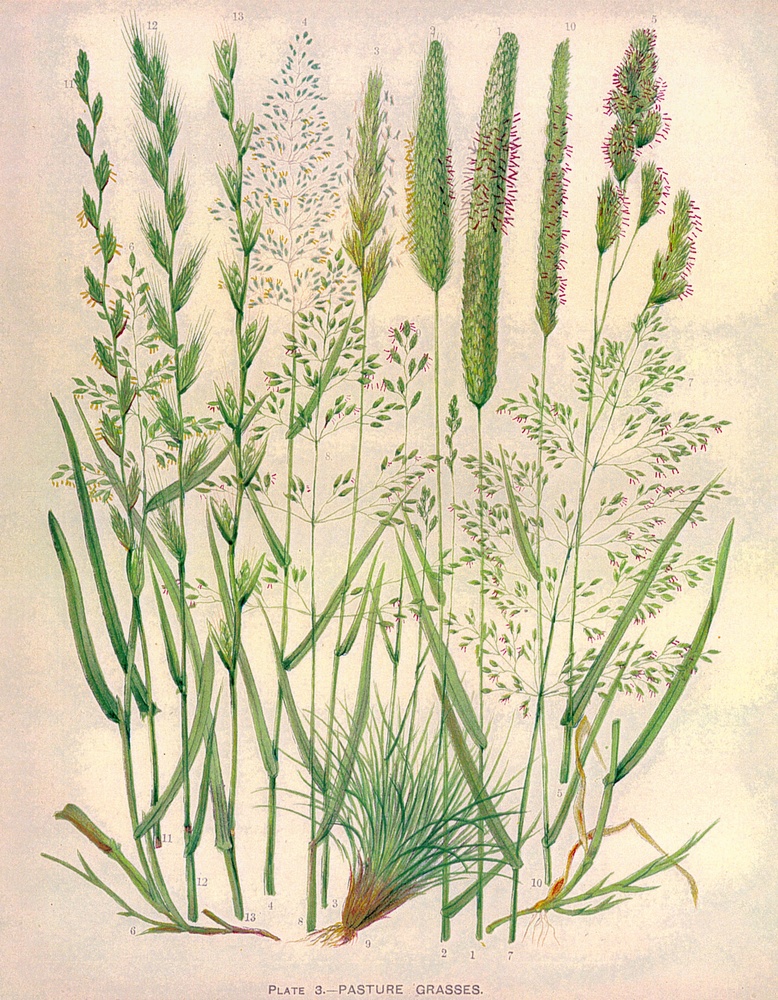
Credit: Woods, R. H.“ Plate 163 (Illustration of Pasture Grass).” Special Collections, USDA National Agricultural Library.

In her book, Braiding Sweetgrass, Robin Kimmerer (Potawatomi), joins the present with the past:

‘Breathe in [the scent of sweetgrass] and you start to remember things you didn’t know you’d forgotten. Our elders say that ceremonies are the way we “remember to remember,” and so sweetgrass is a powerful ceremonial plant cherished by many Indigenous nations.’

Writing postcards is my way to remember not to forget. ###

My book weaves the past with modern policies that affect Native American communities.

###

#chinook

#clatskanie

#clatskanieriver

#celilofalls

#columbiariver

#cynthiacoleman

#greatvowmonastry

#indigenouswaysofknowing

#landacknowledgements

#nativeamericans

#nativepress

#nativescience

#nativewaysofknowing

#oregonnatives

#osage

#postcards

#robinkimmerer

#braidingsweetgrass

#sweetgrass

Posted in american indian, framing, history, nativescience, Oregon, propaganda | Tagged , , , , | 3 Comments

POSTCARDS AS COMMUNIQUES When Indigenous History Gets Overlooked, Ignored

[The Wasco and Wishram lived along what is now called Hood River in Oregon, and lost their territory to settlers in the 1800s. Edward S. Curtis captured an image of a Wishram girl in 1909. Photo from the Library of Congress, in the Public Domain.]

A Postcard Tradition

Picture postcards in the US have long presented an affordable way to share beach vacations with relatives, and offer a quick channel to keep in touch.

My introduction to writing-in-brief came in the 1960s from my mum, who sent postcards from around the world (literally) to her relatives and friends.

She would find a rack of cards in a candy store or tobacconist’s—at the Souk in Esfahan, Iran, or at Olivera Street in Los Angeles (she pronounced the city like the 90-degree line-drawing in your Trigonometry text—”Las ANGLE-less”) and buy two handfuls of picture postcards.

Mum would find a place where she could light up a menthol cigarette, drink a gin-and-tonic, and send off a missive about her latest excursion to a pal stateside.

When her mother died, we discovered my Eeko (grandmother) kept a scrapbook of all the postcards mum sent, which covered regions ranging from the Soviet Union to our Native reservation in Oklahoma.

I fully embraced my mother’s custom of writing postcards, which—for many years—I could find at most community pharmacies or five-and-dime stores when I returned to the States for college.

When visiting a Native history exhibit in Chicago, I searched for postcards that reflected the display, or ones that explored the area’s rich history of Indigenous peoples prior to settlement, so I could share the exhibit with others.

The Potawatomi, Kickapoo, Miami, HoChunk, Wyandot, Chippewa and many more communities and tribes call the region home.

While I could find cards of the jagged Chicago skyline, the gothic Tribune skyscraper and the beloved Cubs baseball team, the closest I got to Native Americans was a postcard of the men’s hockey team named for the Sauk warrior Black Hawk.

There seems no market in the postcard business for Illinois’ Indigenous history, and on visits of late to Albany (New York), Washington DC and the Oregon coast—and even in Portland where I live—I find no postcards acknowledging aboriginal peoples.

I began making my own.

Hand-made Cards

In my earliest attempts I glued my own photographs to card stock for a homemade communique.

To share some aspects of Indigenous life in Oregon, I chose images of plants (such as skunk cabbage—Symplocarpus foetidus—used for Indigenous medicine) and drew pictures of cicadas (once consumed by tribal communities in the Midwest) when they emerged from underground hibernation.

I graduated from glue to the printed press, and created cards with snaps I took of Wounded Knee (South Dakota), Wy’East (Mount Hood) and Loowit (Mount St. Helens).

With each card, I included a few sentences about Native history of the region. 

The more I travelled, the more I looked for traces (and especially acknowledgements) of Indigenous lives, and not just in museums—street names, plaques, statues—any mention of Native peoples. 

Now I prepare in advance for travel, meaning, I read about local, Indigenous history before I make a trek.

Sometimes in my research I find images of local denizens, such as the Wishram girl pictured above.

Her image graces the front of a card I made when I travelled to Hood River, which compelled me to learn about the communities where lives were ravaged by settlers claiming the lands as their own and by dams at the Columbia that forever changed the ecological relationship between the original peoples and river life. 

Recently I’ve been researching denizens who lived near Clatskanie, Oregon—an area named for the Tlatskanhi people—and current home to the Buddhist community at Great Vow Monastery, where I am a lay member.

In addition to the Tlatskanhi and Chinook, the region was peopled by the Clatsop on the Oregon coast (where Lewis and Clark ended their westward journey before returning homeward) and the Cowlitz tribe to the east, near Longview (Washington). 

Scholars conclude that as many as 90 percent of the Native peoples on the coast and near the Clatskanie River perished after the arrival of settlers, most likely because of diseases, such as smallpox, measles, typhoid, pertussis and malaria. 

Dr. David G. Lewis (Grand Ronde) notes in his 2023 book, Tribal Histories of the Willamette Valley, the Tlatskanhi and Chinook were removed to a temporary reservation in 1855 and, again, in 1856—to the Grand Ronde reservation—although few remained to face the 100-mile journey.

One scholar, John R. Swanton, noted in a 1953 report that only eight individuals survived by the time of their move to Grand Ronde, according to ethnologist James Mooney’s 1928 account..

Swanton says Mooney estimated 1600 Tlatskanhi were alive in 1780, and that most had perished by the mid-1800s.

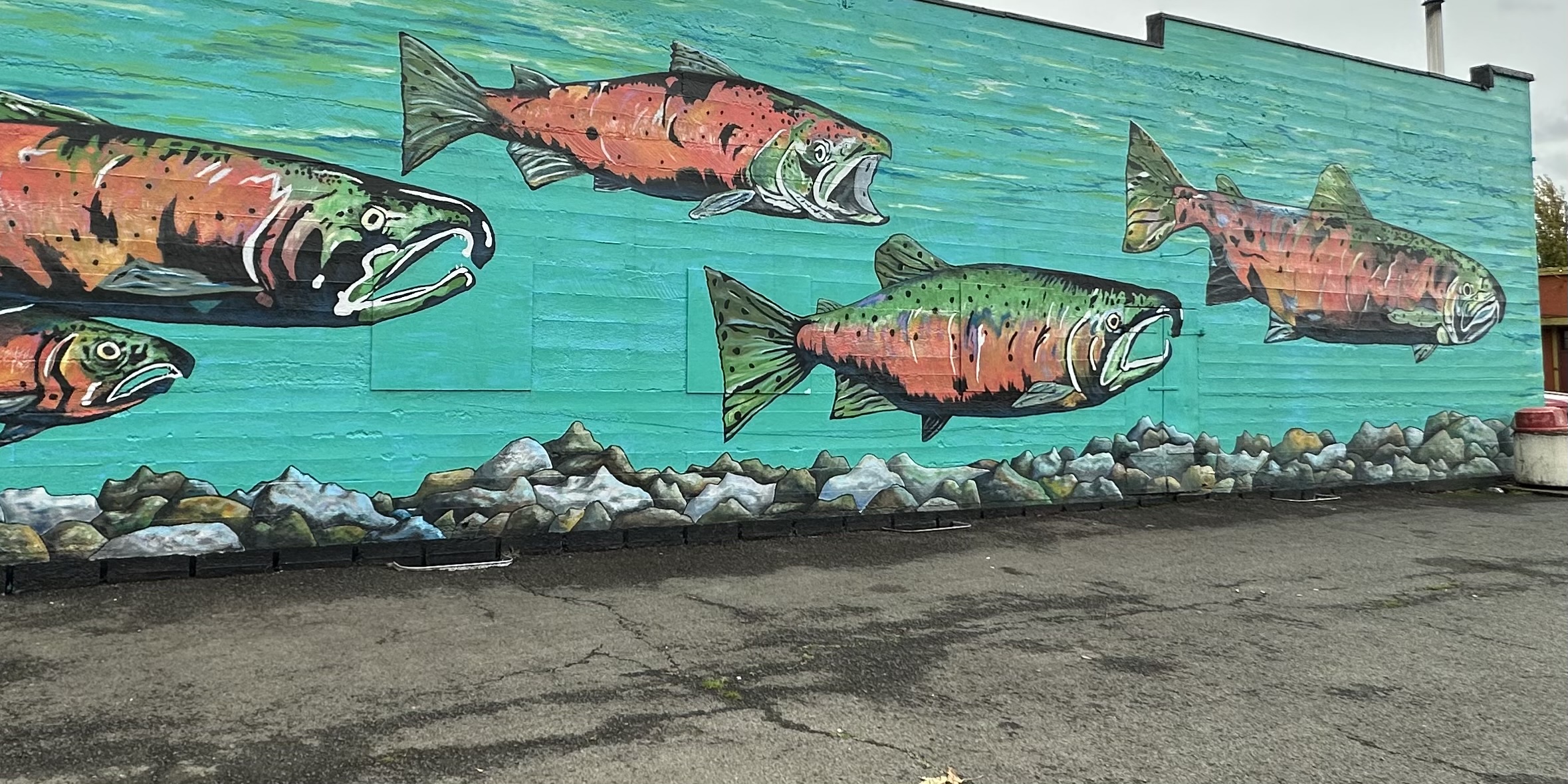
My search for images of the Tlatskanhi people has been fruitless, so when I designed a card to pass along a bit of local history, I snapped a picture of a mural in downtown Clatskanie of Chinook salmon, swimming upstream.

The salmon mural, titled, “Homeward Bound,” was completed in 2020 by Mark Kenny, and funded by the regional arts council.

The picture reminds me how Native people’s lives here are tethered to the fish and their life cycles.

And tomorrow I will begin my morning as usual—sitting on the porch with a cup of hot tea, my dog at my feet and my human companion by my side—and I will welcome the summer’s warmth while I breathe the air.

And then I will write a batch of postcards that share a story about the Clatskanie people, who inhabited this part of the world for some 10,000 years.

And I will ask my readers not to forget them.

[Chinook salmon welcome visitors on Nehalem Street in downtown Clatskanie. The mural by Mark Kenny, titled Homeward Bound, was completed in 2020. Photo by C. Coleman Emery.]

Thanks for listening, and please excuse the advertisements. I am looking into how to avoid them while keeping the blog affordable.

Cynthia Coleman Emery

7 August 2024

#nativescience

#greatvow

#clatskanie

#oregonnatives

#landacknowledgements

#nativeamericans

#wishram

#nehalem

#chinook

#hoodriver

#columbiariver

#wishram

#nehalem

#chinook

#hoodriver

#columbiariver

#indigenouswaysofknowing

#nativepress

#nativewaysofknowing

#nativewriter

#osage

Posted in american indian, authenticity, nativescience | Tagged , , , , , | 2 Comments

NOVEMBER 2023

NATIONAL NATIVE AMERICAN HISTORY MONTH

My Mother is Watching Me

Margaret Sue Barnes Coleman

Some Sundays we drive 90 minutes North of our Portland home, paralleling the Columbia River, headed for the Zen Monastery in Clatskanie (Oregon), where we spend the morning meditating and then listen to a dharma talk (I translate “dharma” as truth).

We then break for lunch and visit with second daughter (Wey-Wee-Nah), who is spending several weeks at the Monastery as a resident.

Meditation (Zazen) is offered during two periods Sundays with a stretching and walking break in between, ending with a talk and acknowledgments before lunch.

During the break, we stretch and then walk slowlyat firstbreathing into each step, and then walk quickly around the meditation cushions on the wooden floor of the Zendo for several roundabouts.

We are instructed to walk heel-toe.

I walk toe-heel.

I walk this way to remind me thatalthough I formally became a Buddhist a few years agoI am a descendent of Osage and Sioux (Kiyuska) Native American families (and French and English settlers, too), and when women walk at our traditional dances in Oklahoma, we place our toes first, followed by our heels.

I tell myself I am not disrespecting the Buddhist traditions.

Rather, I am honoring my mother’s and grandmother’s traditions.

To be Native, I tell myself, is to recognize beingness as a constantlike breathingand not only during occasions like pow-wows or National Native American History month.

We carry our Indigeneity with us, always.

Our Ancestors are with us: Always

On my most recent visit to the Monastery I slipped into the dining room during the break for a sip of coffee, and, while gazing at the empty chairs and tables, I thought I saw my mother looking at me.

I squinted.

From across the room, I saw of photograph of my mother, Margaret Sue.

She smiles brightly for the camera in her formal Los Angeles County Deputy Sheriff’s hat and jacket, which is highlighted by a shining badge on her breast pocket.

Margaret Sue was a member of the department for several years in the late 1950s and early 1960s when my father was unable to work as a result of a brain tumor, and she had four daughters in her care.

During lunch at the Monastery, second daughter explains that the table with my mother’s photo was decorated with pictures from residents to honor their memories of family members.

Daughter carries the image of my mother with her, which was used to make a colorized copy for the display.

Maybe it was my mother’s smileor maybe just my Sunday frame of mindwhen I discovered I felt welcomed by seeing her during the break, as though it was OK to be a descendant of First Peoples and a practicing Buddhist at the same time.

Her presence seemed especially salient knowing that the Monasterythe former Quincy-Mayger schoolwas constructed on soil rich in Indigenous history.

All along the Columbia River Valley, which stretches more than 1,000 miles from Canada to Oregon, Native peoples called the region home “from time immemorial.”

That’s about the distance from New York City to Ames, Iowa.

And 1,000 miles is the length of the forced-march of the Cherokee from Georgia to Oklahoma during the Trail of Tears ordered by President Andrew Jackson in the bleak winter of 1835.

The Columbia River Valley’s Native History

Long before Sacagawea (Lemhi Shoshone), Meriwether Lewis and William Clark traversed the West in the early 1800s, the Columbia River Valley was peopled by dozens of Indigenous communitiessome cordial to one another and some more ornery.

Western historians posit that Chinookean peoples lived in the region of the lower Columbia River (where the Monastery is now located) for millennia, where they were active fishers and traders.

According to the National Parks Service, the Chinook controlled much of the fishing commerce in the region until the Clatskanie peoplewho had lived on what is now called the Washington side of the river“crossed the Columbia.”

“As game became scarce and their food supply diminished, they [the Clatskanie, orTlatskanai, Clackstar, Klatskanai or Klaatshan] crossed the Columbia River to occupy the hills above the Clatskanie River, driving away…the more peaceful Chinook Indians.”

Although historians disagree on when and where the Clatskanie displaced the Chinook people, it was the settler-emigrants who dispatched Native life as they trekked along the Columbia and Willamette river valleys, bringing with them typhus, cholera, smallpox and measles: death sentences for communities with little-to-no resistance from foreign diseases.  

In the early 1840s, a self-appointed “provisional” government of settlers declared emigrants could “own” up to one acre of land: a decision never sanctioned by Native peoples. 

Settler records note local tribal peoples either moved away from encroaching travellers or were rounded up and forcibly relocated to unfamiliar land in the Pacific Northwest.

And while the Clatskanie city website says the area “was named after the Tlatskanai tribe of American Indians,” history books report that most of the tribal folks succumbed to diseases brought by settlers.

The town’s first newspaper was founded in 1889 (three years before Clatskanie became incorporated as a City) and was called The Clatskanie Chief, a name it held until 2014, when it became, “The Chief.”

Synopsis

Back at the Monastery, the Sunday service closes with an acknowledgement of our Buddhist ancestors, beginning with the Buddha, and a listing of the names of the teachers in the lineage of the Monastery’s founders, Jan Chozen Bays and Laren Hogen Bays.

I feel joyful imagining my mother and her ancestors are watching over me while I meditate with members of my Zen Buddhist community.

And I look forward to a moment when the Monastery community finds a bridge with the region’s Indigenous ancestral community.

~ Cynthia Coleman Emery

7 November 2023

# # #

#Buddhism

#Chinook

#Columbiariver

#Clatskanie

#Eightfoldpath

#Indigenouswaysofknowing

#Killersoftheflowermoon

#Kiyuska

#Lakota

#NativeAmericanHeritageMonth

#nativepress

#nativescience

#nativewaysofknowing

#nativewriter

#Osage

#Osagenation

#sioux

#Truth

#Truthandreconciliation

#Wahshashe

#WahZhaZhe

#WahZhaZhe Always

#Whatstrending

#zenmonasteryclatskalnie

Posted in nativescience | 2 Comments

INDIGENOUS PEOPLES DAY

Four Osage sisters create the heartbeat of the new film, Killers of the Flower Moon (2023), which is based on David Grann’s 2017 book about the murders of tribal members in the early 20th century. Pictured, from left, are Rita, Anna, Mollie and Minnie. (Credit: The Osage National Museum/Doubleday. Date missing).

9 October 2023

The second week of October welcomes National Indigenous Peoples Day, which President Joe Biden proclaimed in 2021.

And while the country continues to attend to Columbus Day as a federal holiday (closing banks and the Post Office) individual states ˗˗ including my home-state of Oregon ˗˗ observe Indigenous Peoples Day.

That is, the Oregon legislature agreed to replace Columbus Day with Indigenous Peoples Day.

I like to observe Indigenous Peoples Day by first honoring it, and second, by sharing stories about my family—the Osage and Sioux side—and my scholarly work on Native American communities to help increase awareness of Native ways of knowing.

October also marks the US premier of a new filmKillers of the Flower Moon, which tells the story about murders of Osage citizens in the 1920s, described as “The Reign of Terror.”

My grandmother, who was born in 1904, was among my relatives in Oklahoma who lived through the trauma.

I will share my thoughts about the uprooting of people from a more global perspective, and then focus on the Osages.

I end with why I believe Truth and Acknowledgment are important first steps in reconciliation with Native peoples.

PART 1

Deracination

It takes imagination—and guts—to envision you are part of community that is overtaken by outsiders or displaced by insiders.

I think about it. A lot.

What is life like, if you or your forebears are Palestinian, African, Russian, Brazilian, Armenian, Tibetan, and (or) Indigenous North American?

Displacement carries a harsh pronouncement: it refers to “deracination,” which is Latin for uproot (not for “race,” although it sounds like it).

POLAND

With Indigenous Peoples Day inked on the calendar the second week of October, I try to imagine how residents of—for example—Poland felt in 1939 when Germany invaded.

Poles—whether Jewish or non-Jewish—were considered by the Nazis as “racially inferior.”

“Germans shot thousands of teachers, priests, and other intellectuals in mass killings,” according to the Holocaust Encyclopedia.

Nazis “sent thousands more to the newly built Auschwitz” and other prison camps in Germany, “where non-Jewish Poles constituted the majority of inmates until March 1942.

“Hitler intended to ‘Germanize’ Poland by replacing the Polish population with German colonists,” the encyclopedia says.

INDONESIA

Imagine you are Native to Indonesia when the Dutch arrive in the 1800s to claim Java as their own.

The Dutch required Indonesians to turn over profits from their crops to the new overlords.

Soon, nearly 20 percent of Holland’s national income came from Java.

Rice, corn, peanuts, sugarcane, coffee, sweet potatoes, cassava, sesame and more helped fuel the Dutch colonial appetite.

George Catlin (1796-1872) finished a painting titled “Three Osage Braves” in 1841. Unlike many painters of the time, Catlin personally encountered the Osages, whom he described as, “the tallest race of men in North America.”

PART 2

The Wah-Zha-Zhe

My Osage (Wah-Zha-Zhe) ancestors share a part of history with many Native peoples of North America who tried to ignore, reason, barter and kill invaders.

Turns out Thomas Jefferson envisioned a plan appeasing to the settlers while disastrous for Native communities.

Jefferson devised a scheme to pay Napoleon for French holdings in the United States, and he informed tribes that they (Indians) would occupy all lands west of Louisiana once the deal was brokered in 1803.

Osage ancestral homelands include parts of Louisiana and other territories, both east and west—and we sent delegations of our people to meet with Jefferson in 1804 and in 1806 in an effort to iron out details of the acquisition.

Jefferson promised that—if the Native people agreed—we would have complete ownership of territories west of Louisiana.

But the promise was never kept.

Foot by foot and mile by mile, invaders staked out lands further and further west, creeping through areas promised to—and occupied by—Native people.

By the time Missouri received statehood after the purchase, in 1821, some 5,000 Osages faced deracination.

Osages and other tribal peoples were attacked by settlers as we were prodded and pushed in myriad directions: from Missouri to Arkansas and then Oklahoma, and then to Kansas.

POST-SCRIPT: LAURA INGALLS WILDER

The beloved author of the Little House on the Prairie books—Laura Ingalls Wilder—would later learn her parents were among the invaders who built homes on Osage land in Kansas.

Laura McLemore, an expert on Wilder’s books, notes that the Ingalls family was “part of an illegal rush of settlers into the Osage” reserve in the late 1860s.

“Few people today realize, and perhaps Laura herself didn’t know, that a section of Kansas was once called Indian Territory” in reference to Jefferson’s political machinations, McLemore notes.

McLemore writes that, “in the early pages [of Little House on the Prairie] Laura quotes Pa as saying that animals wandered ‘in a pasture that stretched much farther than a man could see, and there were no settlers. Only Indians lived there.’

“Pa chose to ignore the fact that the land and everything on it belonged to the Osage people.

“He freely cut logs to build a house, hunted wild game for food and furs, dug a well and broke the land for farming,” McLemore writes.

Skirmishes between the Osage and homesteaders like the Ingalls forced my ancestors to find another home.

David Grann notes in Killers of the Flower Moon that Osages decided to purchase acres of inhospitable land in Oklahoma to the South, figuring the territory so desolate they would finally be left in peace.

Map of traditional Osage lands and the current reservation. Courtesy of the Osage Nation

BACK TO OKLAHOMA

The 1871 “expulsion” to Oklahoma “was worse in terms of lives lost and hardships” according to Osage scholar Louis F. Burns.

“This move almost destroyed the Osage people. Old tombstones indicate the greatest toll was among young mothers and infants.

“Yet the old people who made the move never spoke of the deaths and sorrows,” Burns notes.

As part of their agreement with the US, the Osages negotiated to “maintain all the subsurface rights, mineral rights to our land.”

The agreement would prove serendipitous once oil was discovered at the turn of the century.

PART 3

Oil Discovered

Still, it would take several years to harness crude oil production, which required serviceable roads, vehicles, digging, drilling and rigging.

Meantime, Osages were “counted” as being enrolled by the US government until July 1907, when the tally of citizens was officially designated.

The list of more than 2,200 Osages included my grandmother (and siblings) and her mother—and each received a headright that resulted in payments from oil and other income-generating sources.

Such payments would label the Osages the richest people, per capita, in the world.

Burns writes the newly acquired wealth “attracted money-hungry outsiders” who found the means to inherit a headright [a practice now outlawed] by using grisly ways to murder Osages.

“The so-called Reign of Terror, in which a number of Osages were murdered for their petroleum wealth, ended only when the newly formed Federal Bureau of Investigation (FBI) won a conviction in federal courts,” Burns writes.

Osage-Sioux writer Fred Grove, who has written about the murders. Uncredited photo from the Arizona Daily Star.

SCORSESE’S FILM DEBUTS

Martin Scorsese’s new film—which opens in US theatres beginning October 20—was called, “a roaring crime saga about the murders that plagued the tribal nation starting in the 1920s, as the Osage’s neighbors and family members set out to strip them, by any means necessary, of their oil rights,” according to Melena Ryzik of the New York Times.

One of the Times‘ leading critics, Manohla Dargis, attended the film’s premier in Cannes, and called it, “shocking, at times crushingly sorrowful, a true-crime mystery that in its bone-chilling details can make it feel closer to a horror movie.”

The Reign of Terror has been long buried by many families but not forgotten.

My grandmother refused to talk about “the times” because “it is too painful.”

The film exposes a contradiction, in that the stories about the murders were closely guarded at home, and yet, several writers—including two of my relatives—hoped to write their views on the Reign of Terror.

Fred Grove, an award-winning author and my grandmother’s kid brother, was a youngster when he heard a late-night blast that shook their house which turned out to be a bomb that blew up a home where Rita Smith, Mollie’s sister, lived (pictured above).

Uncle Fred told a reporter that, the next morning, his mother, “told me not to go over there, but I sneaked off, and was sorry I did…There were pieces of flesh all over, and the house was just a pile of sticks. That stuck with me.”

Fred would later write a manuscript with the FBI official who investigated the murders, Tom White.

But the book was rejected, and Fred instead published a fictionalized version of the Reign of Terror in, The Years of Fear, his favorite book.

“This is close to my beginnings as a writer….my feelings, my heart.”

An uncredited image of an oil well from the 1920s in Osage territory. Source: Website “Famous Trials.”

NOTABLE CONTRADICTIONS WOVEN TOGETHER

The stories of the Osage murders bring into focus contradictions of ethics, ways-of-knowing, and how we remember history.

As Louis F. Burns noted in writing about the Osage removal in the 1800s to Oklahoma territory, “the old people who made the move never spoke of the deaths and sorrows.”

I have felt the conflict personally and professionally.

As a writer with a doctorate in journalism, I learned that good narrators advocate for unabridged sharing of information and truth-telling.

Yet, the more I learn about Indigenous aspects of story-telling, the more I feel conflict between Native ways and journalistic ways.

In Native communities, I have learned not all stories need to be shared.

Ethics are woven through our observances and practices, some of which are cloistered.

For example, we ask permission from our elders to share stories and songs.

Visitors are forbidden from taking photographs of ceremonial events, such as the In’Lon’Schka annual dances.

We revere ceremonial clothing and are distressed when our dress is mocked (as Halloween costumes) and when customs are appropriated as part of sports teams mascots and cartoons.

PART 4

The Value of Truth and Acknowledgment

Native American Day invites us to greet the day through the lens of Indigenous peoples.

I offer two ideas to help imagine the world through the lens, which, as I noted earlier, is threaded with ethics.

The first is Truth.

While all cultures honor truthfulness, Native North Americans have suffered disproportionate harm from lies, assumptions and “alternative facts” over land swindles, forced schooling, geographical isolation, sterilizations and murder.

And that means clearing away the historical camouflage that shrouds Indigeneity.

A national project has been launched called Reclaiming Native Truth, which encourages support of narratives about American Indians from American Indians “to foster cultural, social and policy change by empowering Native Americans to counter discrimination, invisibility and the dominant narratives that limit Native opportunity, access to justice, health and self-determination.”

The project urges folks to deconstruct time-worn narratives that dominate our social fabric by bringing into view perspectives from Indigenous peoples, rather than perspectives about Indigenous peoples.

One small truth takes us full circle to the beginning of this essay—Indigenous Peoples Day—in light of seeing Columbus Day through a Native gaze.

It is worth taking time to remember that North Americans already existed before Columbus mistakenly believed he landed in Asia in a territory he later called “The Indies.”

And myths of a free, virgin, vast and uninhabited land continue to underpin much of the falsehoods about the West and Native Americans.

Which brings us to the second notion: Acknowledgement. 

I have learned that truth and acknowledging truth are fundamentally ethical ways of thinking and acting.

This observation crystallized while I was finishing a book about American Indians, Western science, the environment and mass media.

During this time I was also studying Zen Buddhism with the goal of becoming—formally—a Buddhist.

The framework of Indigenous ethics (inspired by writings from scholar Vine Deloria Jr.), which is foundational to my book, connects seamlessly with Zen teachings.

For example, Buddhists embrace an ethical life by contemplating the noble Eightfold Path, which includes truth and acknowledgment, through wise (“correct” or “right”) understanding, thought, speech, action, livelihood, effort, mindfulness and concentration.

I put this into practice when I travel—whether for work or pleasure.

For example, we spent a few days this summer hiking and swimming while visiting the city of Mt. Shasta in Northern California, a community of about 3,200 folks.

I learned Indigenous peoples lived in the region since—as they say—“time immemorial,” meaning, no one can remember when humans first walked here.  

Turns out the name “Shasta” reflects the Native name of the Shasta (or Sastice) peoples, who occupied the area along with Modoc, Ajumani-Atsuwgi, Karuk, Wintu and other Indigenous peoples.

Learning about the Indigenous inhabitants of a region is an important part of my practice of Truth.

As for Acknowledgement, I share what I learn on my journeys by writing essays for my blog, posting photographs on social media, writing letters and postcards to family and friends, and sandwiching in a bit of history about a place in everyday conversations.

If I am speaking to a group or gathering, I first acknowledge the Indigenous communities that are Native to the region before introducing myself.

For me, Truth and Acknowledgement are actions—not just words—that are crucial to living an ethical life.

###

I honor the Native Peoples on whose ancestral homelands we gather here in the Pacific Northwest.

In concert with the premier of the film, Killers of the Flower Moon, the Osage Nation has released a short video, “Wah-Zha-Zhe Always.”

https://www.osagenation-nsn.gov/news-events/news/osage-nation-launches-wahzhazhe-always-celebrating-culture-and-sovereignty

#Buddhism

#Davidgrann

#Deracination

#Eightfoldpath

#Framing

#Fredgrove

#Indigenouspeoplesday

#Indigenouswaysofknowing

#Killersoftheflowermoon

#Kiyuska

#Lakota

#Landacknowledgement

#Louisianapurchase

#Martinscorsese

#Mtshasta

#NativeAmericanHeritageMonth

#nativepress

#nativescience

#nativewaysofknowing

#nativewriter

#Osage

#Osagemurders

#Osagenation

#Reignofterror

#sioux

#Truth

#Truthandreconciliation

#Vinedeloria

#Wahshashe

#WahZhaZhe

#WahZhaZhealways

#Whatstrending

Posted in nativescience | Tagged , , , | 3 Comments