But how long are they going to be here?

wild-wild-country-2018-poster

The Rajneeshis in Oregon

One of my favorite reads is Frances FitzGerald’s Cities on a Hill (1987), which explores five diverse communities in the United States, including the town in Oregon that became headquarters for the Rajneesh community.

A new documentary, called Wild, Wild Country, tells the story of the community and its rural neighbors, and is now airing on Netflix.

Wild, Wild Country explains how a large gathering of followers of a spiritual leader from India (Bagwan Shree Rajneesh) made Oregon home in the 1980s.

Some 2,000 devotés took up residence in the community near Antelope, according to the Oregonian newspaper.

When I tuned in to the documentary, I was struck by the long-time residents of Antelope, whose worries sounded familiar.

When asked about their community before the Rajneeshis arrived, one offers:

“Everybody knows everybody else, and everybody got along.”

Another remembers getting a phone call from someone who urged him to “keep those guys from getting in” to the community, once news leaked that an 80,000-acre ranch had been sold to the Rajneesh commune.

“We wondered who these people are, why are they here [and] how long are they going to be here,” says another inhabitant.

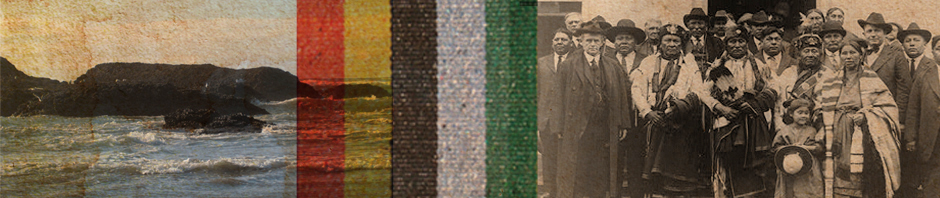
Their anxiety sounded familiar because I had heard about it from Native Americans perplexed by the influx of visitors to our communities.

Before the arrival of the Rajneeshis, Oregon inhabitants worried about “bearded, hairy” strangers–who looked like bears–arriving unexpectedly.

In their “perfect paradise” at the mouth of the Columbia River, the Clatsop people treated the hirsute Russian traders with courtesy, and traded fish for furs.

Then the Russians packed up and shoved off in their boats.
Continue reading

Posted in american, american indian, framing, native american, native press, Native Science, nativescience, Paiute | 3 Comments

A Silent Retreat

IMG_1941 (1)With Cloven Hooves

You have beautiful feet, he said.

In an instant, I wondered what other lies he told.

No one looking at my toes would utter such words.

You wouldn’t dare.

It’s either a fib or a line picked up from some television show.

I knew: the relationship was doomed.

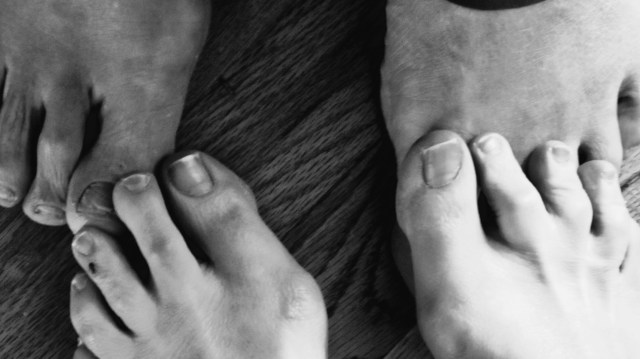
These past few days I’ve thought a lot about feet.

Spending time at a silent retreat at the Zen Monastery means you stare at sockless toes.

One woman—delicate and trim—has blackened soles and toes, which my husband says was probably due to frostbite.

My husband’s feet look pinkish, with toenails formed by a third-grader in a pottery class: gray and misshapen.

Another Zen disciple–a tall woman has elongated flippers–wears toenails painted black.

My toes are painted red to distract wandering eyes from the callouses (tennis) and bunions (mother’s genes).

My toes flare like Spock’s Vulcan salute: Live long and prosper.

My piggy who-went-to-market pairs with the piggy who-stayed-home, while the other three clump together to create the cloven hoof.

The V-shape of five toes looks like Spock’s greeting.

Each foot’s second lieutenant (stay-at-home oinker) looks like an inch-worm caught mid-step: an upside down “V” that’s not at all like its moniker of hammer-toe.

Beautiful?

In a pig’s eye.

###

15 April 2018

#nativewriter

#nativescience

#hammertoe

#becomingbuddhist

Posted in american indian | 1 Comment

Becoming Buddhist

enzoI am inching toward becoming a Buddhist and find myself torn.

When practitioners “become” Buddhists, they are given the name of an ancestor.

And this is where my panic digs in.

It’s not just the accoutrements of religion–the bowing and the incense and the meditation.

It’s the naming.

I understand a “name” is just a label, yet I cling to my birth-name.

One of the Buddhist priests in our community doesn’t use his birth-name anymore.

He says when he mingles with folks in town, rather than giving his birth-name of Fred, he uses his Buddhist name, Tomoya (I’m using pseudonyms for propriety).

He says, “call me Tom.”

Continue reading

Posted in american indian, Osage | Tagged , , , , , | Leave a comment

Indian Horse film delves into Canada’s dark history of residential schools

via Indian Horse film delves into Canada’s dark history of residential schools

Posted in american indian | Leave a comment

Reimagining History

george

Washington Crossing the Delaware (1851) by Emanuel Leutze

Taking Liberty with a Grin

Colescott

George Washington Carver Crossing the Delaware: Page from an American History Textbook (1975) by Robert Colescott

Can you close your eyes and imagine the famous painting of George Washington crossing the Delaware?

Remember the general standing tall, facing the wind, in a tiny boat?

An American flag unfurls while sailors guide the craft through chunks of ice.

It’s nighttime, Christmas, 1776, and Washington is planning to attack a group of Germans (British allies) in Trenton, New Jersey.

Earlier that winter, Washington and his troops were driven from New York, south to New Jersey, and morale ebbed low among the Americans.

Washington’s surprise attack in the freezing early-morning hours would prove a success.

Today the Christmas-time battle is considered a turning point in the American Revolution.

Continue reading

Posted in american, american indian, history, Seattle Art Museum | Leave a comment

The sound I make

Thugly truth

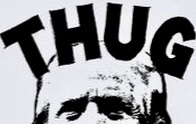
After the first shock-wave hit the internet—Stormy Daniels’ tell-all on 60 Minutes about her sexual encounter with the US president—media pundits turned their gaze to thuggery.

Editorials surfaced in the second shock-wave that focused on threats made to Daniels to keep mum on the affair, once she told Anderson Cooper that a stranger pulled a Sopranos move.

The stranger “looked at my daughter and said: ‘That’s a beautiful little girl. It’d be a shame if something happened to her mom’,” Daniels says.

And a moniker takes hold: President-as-thug.

Armed with the headline, All the Presidents’ Thugs, The New York Times’ Editorial Board chastised the thug-in-charge, observing:

We live at a time when a porn star displays more credibility and class than a president, his lawyers distinguish themselves through swagger more than legal skill, and we seriously wonder just how thuggish the man in the Oval Office is. It seems like a bad dream.

The word thug originated in India, according to the Oxford English Dictionary. Continue reading

Posted in american indian | Leave a comment

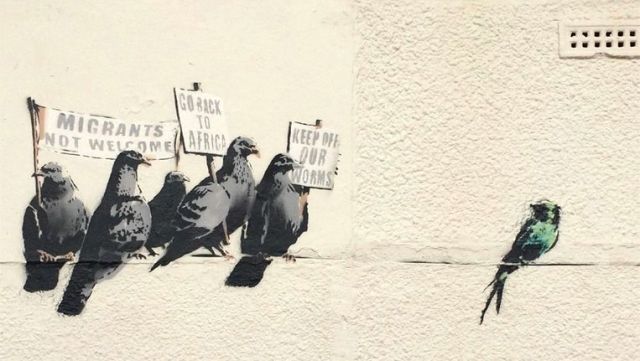
When is a Terrorist a Terrorist?

banksy

It’s all about Semantics

Some words we toss around with abandon, having little idea what they mean:

  • Hegemony
  • Rhetoric
  • Semantics

We often use them incorrectly.

We think of hegemony as power over us, but Antonio Gramsci had a keener sense of the word.

Hegemony refers to domination we muggles accept blithely.

He wrote, “Ruling groups dominate not by pure force but through a structure of consent.”

Rhetoric just means speech, but it is often assumed to mean false speech or speech with a hidden agenda.

And semantics?

Semantics is the study of language.

Continue reading

Posted in american indian | 2 Comments

The Menace that Threatens “True Americanism”

Klan-sheet-music (1)

A closeted French philosopher, an immigrant from Jamaica, a Jew who fled the Nazis then killed himself, and a feminist who writes about film.

Does this sound like the foundation for a college communication course?

When my communication class starts in April, students will be mystified: what do these folks have to do with communication?

Taking baby steps, students learn a French philosopher (Michel Foucault) says that communication itself is a form of power—that those who frame public discourse help frame what we think is important.

The immigrant from Jamaica (Stuart Hall) points out in an often-cited article that people decode messages in ways that reflect their cultural knowledge.

Continue reading

Posted in american indian, ethics, fucktrumpet, immigrants, KKK, propaganda | Leave a comment

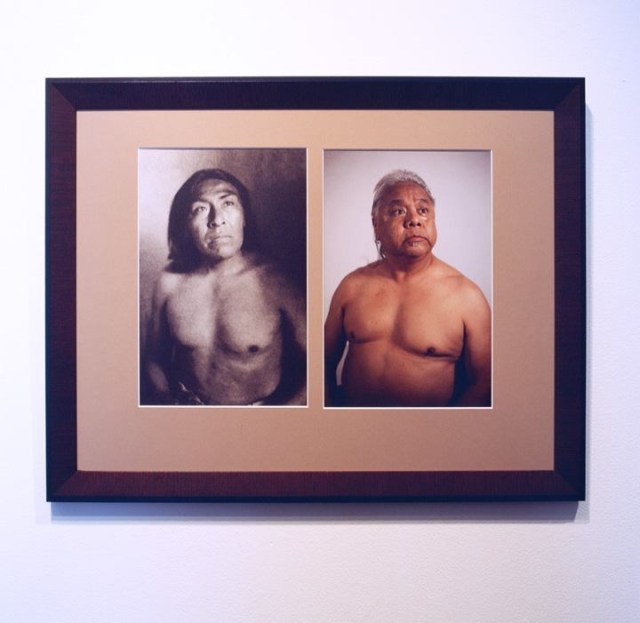
Remembering James Luna, Who Gave His Voice and His Body to Native American Art

Lara/Trace's avatarLara Trace Hentz

Luna’s unexpected passing at the age of 68 interrupted a steady flow of thoughtful and provocative performance art.

READ: Remembering James Luna, Who Gave His Voice and His Body to Native American Art

I had posted about James prior on this blog. He was articulate and funny and a real warrior in his art. I only met him once.

“James Luna is one of the most important contemporary Native artists of our day,” said Patsy Phillips, director of IAIA Museum of Contemporary Native Arts, in a statement to Hyperallergic. “His art and contributions to the art world will live on in institutions and publications, but more importantly he will live on in perpetuity in people’s minds and hearts.”

View original post

Posted in american indian | 2 Comments

Let them eat Girl Scout cookies

thin mints

As spring finally arrives in the Northwest, the daffodils poke out of the last clump of neighborhood snow and Girl Scout cookies arrive.

My sweetheart and I share a sleeve of thin mints that disappear in a flash.

Tucking the green box into the freezer offers little protection to the cache of cookies because we’ll eat ‘em icy.

My sisters and I enrolled as Brownies, and then Girl Scouts, when we were young.

Our mum thought Girls Scouts offered avenues for personal growth and she saved money to buy uniforms.

We wore our outfits once a month, earned badges for our sashes, and learned how to make a kit-bag for camping.

When we were urged to venture door-to-door to sell cookies to neighbors, I balked.

Continue reading

Posted in american indian | Leave a comment