We’ve been ringing our hands over the role of politics in science.
And for good reason.
Politicians and scientists have come to loggerheads over stem cell research, the Morning After pill (also called Plan B) and climate change. Continue reading

We’ve been ringing our hands over the role of politics in science.
And for good reason.
Politicians and scientists have come to loggerheads over stem cell research, the Morning After pill (also called Plan B) and climate change. Continue reading
 Being surrounded by social media aficionados brought out the Luddite in me, with constant reminders of how little I know about tweeting, blogging and modern conversations in the virtual world.
I needed a field guide to navigate the ScienceOnline2012 conference in Raleigh while learning a whole new vocabulary. Continue reading
 Over the last few days I’ve been floating in a bubble of conversations about science with some 350 writers, bloggers, teachers and scientists from the US and abroad. We gathered under North Carolina storm clouds to talk about science.
What we share in common is an appreciation (and for some, a love affair) with things scientific, ranging from the science of bugs to the role of science in a democracy. But more important we all share the belief that science needs to be communicated—and communicated well—to a variety of publics. Continue reading
 In daily discourse we distinguish between the heart and the mind, emotion and cognition.
And as a former journalist and professor of journalism we learned to separate feelings from facts, and to view the world though an unjaundiced, distant and objective eye. Continue reading
 In my field we think about the role of self-esteem and self-efficacy when it comes to behavior.
How we think about whether we’re equipped to accomplish a task influences if we attempt something new.
In the wake of New Year resolutions I was wondering out loud about the influence of self-efficacy when a friend said an apt metaphor to describe this attribute would be a rock. Continue reading
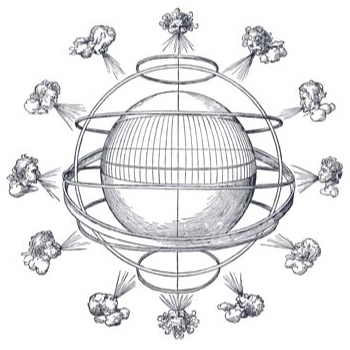
Woodcut by Albrecht Durer
But when is it appropriate to withhold information? Who gets to decide what information is sequestered and from whom?
A recent struggle has embroiled scientists and journalists in the thorny discussion of censorship. Continue reading
One critic charges that Western Science separates facts from values. The provenance of science is to define the facts, while “politicians and moralists” are left to define values.
Problem is, according to Bruno Latour, you cannot distinguish facts from values, or the rational from the irrational. Continue reading
 As far as technological savoir faire is concerned, I squat a long distance from the apex of knowledge.
Most of my friends and colleagues long ago bought smart phones and would be considered Early Adopters by communication scholars. There are a few holdouts (including fellow professors) who refuse to buy a cell phone. Continue reading
 The current edition of Newsweek is chock-full of stories that will make you happier and healthier.
Or not.
The writers have fallen victim to the false reasoning that you can apply scientific results to your own particular case. Continue reading
faulty scientific logic in journalism


 Cynthia (Ištá Tȟó Tȟó) Coleman Emery's Blog