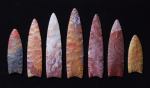
Clovis points
“It is no exaggeration to say that America was founded on innovation.”
Having spent November steeped in American Indian ways-of-knowing (I pledged to write each day about Native American Heritage Month) made me acutely aware of our perceptual lenses.
Today I see the Smithsonian magazine statement with new eyes.
America was not founded. It was already here.
The point of the magazine is to herald innovations: I get that.
What I object to is the assumption that innovations commenced at the occupation of North America by settlers.
Innovations have long been forged by indigenous people. In fact, the same magazine issue that celebrates North America’s “founding” describes the “deadly but beautiful Clovis point,” a sharpened stone that made hunting more efficient 12,000 years ago.
And its creation occurred long before Columbus arrived.
Photo from http://www.woodyblackwell.com/portfolio.html


 Cynthia (Ištá Tȟó Tȟó) Coleman Emery's Blog
Nice little adjustment there. : )
LikeLike
We have become so used to hearing those semantic hiccups, I think most people don’t even blink at them any more. It’s time to change the paradigm!
LikeLike