LITTLE THEORIES

When Martians land (Credit: Noyes, from openart)
My blog brings together studies of science, culture, media and discourse with an emphasis on issues that impact Native Americans. Today I’m looking at deceptive tactics aimed at persuading you to believe stories that are lies.
I share some ways you can defend yourself against lies, disinformation and misinformation, courtesy of a famous study that sought to answer the question: Why did some residents of New Jersey believe Martians landed in Grovers Mill on 30 October 1938?
We can learn from research conducted 86 years ago that people use the same logic in making decisions—but the logic is often flawed.
When Lying is the Norm
Have we become inured to lying?
I expect some folks involved in politics will straight-out lie to any of us who listens. And there is bountiful proof that politicians lie.
But I want to believe other muggles share my values: that lying is dishonorable, and that speaking truth is virtuous.
Buddhist teachings ask followers to aspire to honesty.
Although we can’t be perfect, the idea that we try to lean into honesty is a worthwhile practice.
We are muggles, after all.
When Lies Cause Harm
A politician’s confession to lying recently—not only made headlines—it begs the question: Does lying matter?
Here’s a recap of the story du jour:
James Donald Bowman, or, James David Hamel, or, J.D. Vance, or JD Vance [no periods]—Trump’s 2024 running mate—told reporters peoples’ pets in his home-state of Ohio are being eaten by immigrants from Haiti.
According to NPR, Vance posted on social media’s X the following statement on Monday, 10 September 2024:
Reports now show that people have had their pets abducted and eaten by people who shouldn’t be in this country.
Trump repeated the lie the next day, during the national debate with Kamala Harris, which was watched by 67.1 million people, according to Nielsen Media Research.
For scale, that’s more than the populations of Australia, Chile and The Netherlands—combined.
Trump said:
” ‘In Springfield, they’re eating the dogs. The people that came in, they’re eating the cats,’ Trump said. ‘They’re eating the pets of the people that live there.’ “
CNN called the claim a lie, and added that the city’s mayor, the chief of police, and the governor of Ohio found no evidence—and no reports from Springfield residents—that anyone is eating pets.

Illustration of Pinocchio by Carlo Chiostri and A. Bongini, from “Le Avventure di Pinocchio, Storia di un Burattino,” 1902. Image is in the Public Domain.
Crooked Paths, Twisted Words
The lie is an example of disinformation, which media scholars define as a fabrication with a purpose, such as persuading publics that, for example, Barack Obama was not born in the US (his birth certificate—which he made publicly available—places his birth in 1961 in Hawaii), as claimed by Trump for many years.
Misinformation is not seen as an intent to deceive, and there may be no truth or some truth to the inference.
For example, scientists now know the best way to transmit COVID is person-to-person—through human aerosols that carry fine particles of the virus.
That’s why masks are effective at reducing your risks of infection.
In the early days of COVID advice, some experts suggested washing paper money and coins, wiping down conveyer belts in the grocery store, and avoiding hand-shakes.
Such recommendations could be considered misinformation, but cleaning coins and sponging surfaces cause no harm and can reduce the spread of some germs.
But misinformation and disinformation from the Republican nominees for president and vice-president have laid a path for harm.
With intent.
On the Sunday following the candidates’ debate, Vance appeared on CNN’s State of the Union and admitted he had lied: repeating over and over a rumor posted on social media that the person who started the lie renounced her claim of pet-eating because she had no evidence to support her words.
Vance admitted he repeated the tale to large audiences, knowing it was false.
Vance defended and normalized lying because he said he needed to, “Create stories so that the…media actually pays attention to the suffering of American people.”
Vance and Trump have since doubled-down on the lies, creating an environment for physical harm when their followers threatened to bomb schools, hospitals and government buildings in Springfield, the city targeted by the politicians.
After 33 bomb threats were made, the Ohio governor called in 36 state troopers to police classrooms for bombs, according to one news report.
The Background Story
For background, I turned to the New York Times, whose expert on immigration reported last week thousands of Haitians fled their country following several waves of political upheaval, including the murder of President Jovenel Moïse in July 2021.
In addition to the US, Haitians have emigrated “in large numbers for a long time to Brazil, Canada, Chile and Mexico,” Jordan notes.
Springfield actively recruited workers to the town by shoring up jobs and turning around its flailing economy.
The city created “thousands of jobs” some years ago, thanks to a “boom in manufacturing and warehouse jobs attracted a swelling wave of immigrants, mainly from Haiti.”
“By 2020, Springfield had lured food-service firms, logistics companies and a microchip maker, among others, creating an estimated 8,000 new jobs and optimism for the future.”
“City officials estimate that as many as 20,000 Haitians have arrived, most of them since the pandemic,” Jordan writes.
Pulitzer Prize-winning journalist, editor and publisher Garry Pierre-Pierre (who is Haitian-American) writes, “In the past, immigrants may have faced hostility but eventually they became part of the fabric of their new communities,” according to MSNBC on Friday 20 September.
Pierre-Pierre adds we’re witnessing division from “hateful rhetoric” voiced by extremists in Springfield and elsewhere.
“Instead of Integration,” Pierre-Pierre notes, talk and action are “designed to tear apart communities like Springfield.”
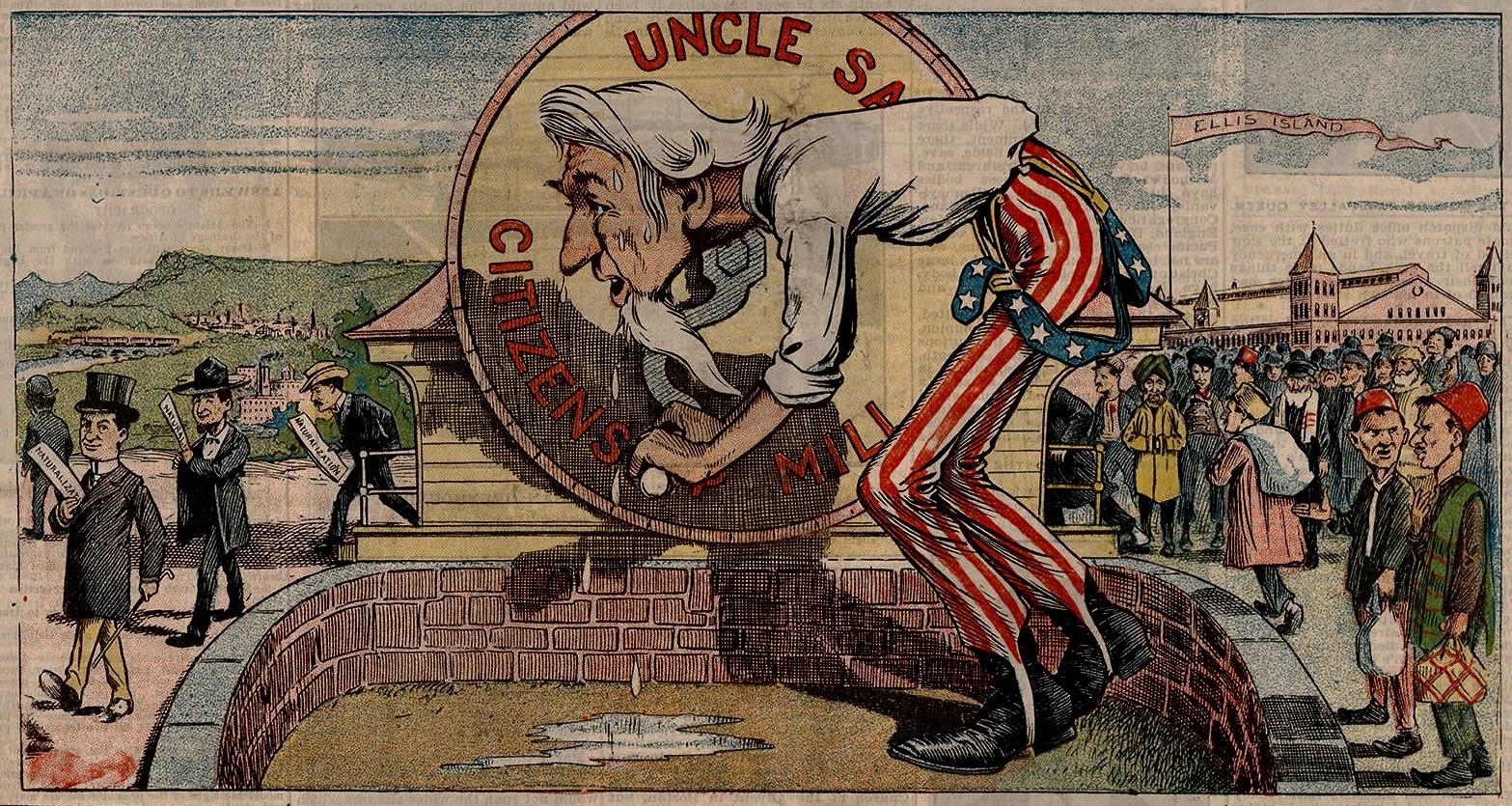
Strangers who landed in North America have long witnessed harassment by skeptic Native residents—from the arrival of settlers on the Eastern seaboard, to the Russian merchants landing on the Pacific Coast in search of fish and fur. Editorials—such as the cartoon from 1903—dramatized the agita of policy-makers, as shown in the cartoon titled, “Uncle Sam Perspires at his Growing Job: He finds turning the crank of the assimilation mill is taxing his strength to the utmost,” 1903. (Photo credit: Ohio University Billy Ireland Cartoon Library & Museum Art Database. Image in the Public Domain).
Preparing for the Onslaught
The looming presidential election brings countless opportunities for outright deception, in addition to endless stories of disinformation and misinformation.
Examples that have gained traction include voter fraud.
Yet, real-life instances of dead people and non-citizens actually voting illegally are minuscule, according to Chris’s Brennan, elections columnist for USA Today.
Brennan notes that when “officials from Arizona, Georgia, Michigan, North Carolina, Pennsylvania and Wisconsin” met recently, they say their “biggest concern” is “rampant disinformation” about the elections, which undermines how people feel about voting.
Americans are mixed when it comes to confidence in voting, according to Pew Research.
Respondents who call themselves Democrats said their faith in elections in 2020 was about 46% (“very confident” and “somewhat confident” responses were combined) and in 2024, Democrats’ trust rose dramatically to 77%.
On the other hand, Republicans had more confidence in 2020 (77%) and less confidence in 2024 (47%).
Clearly lies, disinformation and misinformation have influenced voters’ opinions and actions, but such connections are difficult to demonstrate because researchers find teasing apart how, why and when such beliefs are formed is nearly impossible.
That said, when a crisis occurs with no warning, sometimes researchers can figure out influences of media on beliefs because such events are novel.
That means beliefs have had less time to gel, and survey responses may be more honest.
When Martians Landed in New Jersey
That’s just what happened in 1938, when an 8 p.m. radio broadcast on the eve of Halloween announced that Martians landed in Grovers Mill, New Jersey.
The radio program was an adaptation of HG Welles’ story, War of the Worlds, presented live by the Mercury Theatre on CBS radio.
Some listeners reportedly panicked, believing the broadcast was real-time news (not entertainment), although Wikipedia notes that “the scale of panic is disputed, as the program had relatively few listeners.”
News reports of fearful New Jerseyans caught the attention of Princeton Professor Harvey Cantril, who gathered a team to interview listeners and discover impacts—if any—of witnessing the program’s airing.
Cantril notes that, while some listeners were frightened, no widespread panic ensued.
Turns out most listeners used common sense to check for Martians.
First of all, folks simply looked outside to see if the “poisonous black smoke” emantating from the spaceships could be seen, as the program reported.
Others reasoned that the pacing of the radio play didn’t align with “real” time, because it was compressed, occurring over hours and days.
Some listeners turned the dial on their radios to discern if stations (in addition to CBS) were reporting the invasion from Mars.
Others checked their newspapers for the radio schedule and saw CBS was broadcasting a performance of the Mercury Theatre.
And friends telephoned friends to see whether they saw creatures from outer space in their neighborhoods.
Most listeners sought evidence beyond the broadcast to see if Martians actually landed.
Cantril writes that, among the listeners who believed the news was actually real, some seemed stricken with fear, and did nothing to check their environment for counter-explanations.
And some listeners were influenced by beliefs in God or by the notion the world would end.
Cantril argues—like many scholars today—that individuals rely on decision-making according to a personal script informed by past experiences and infused with ego rather than logic.
Muggles ask, “How does this affect me?”

Reaction to the War of the Worlds Broadcast
Lessons Learned
As ordinary folks and as information consumers—whether we find information via media or friends—we operate with a template for decision-making.
Cantril concluded 86 years ago that ego matters in decision-making, and writes:
When an individual believes that a situation threatens him he means that it threatens not only his physical self but all of those things and people which he somehow regards as a part of him. This ego of an individual is essentially composed of the many social and personal values he has accepted. He feels threatened if his investments are threatened.
Fabulists—those who “invent elaborate, dishonest stories” like Vance and Trump—hope to appeal to our egos with falsehoods that invoke threats that make us fearful, such as the notion that Martians are taking over Grovers Mill.
Or that migrants are taking over Springfield.
Threats, although untrue, are like a battering ram to the ego and demand an emotional response, as the following quotes suggest:
“When Mexico sends its people, they’re not sending their best…They’re bringing drugs. They’re bringing crime. They’re rapists” (Donald Trump, quoted in Politico, 8 July 2015)
Democrats “are not soft on crime….They’re pro-crime. They want crime. They want crime because they want to take over what you got. They want to control what you have” (Tommy Tuberville, R, Alabama, quoted in The Washington Post, 10 October 2022)
“Trump Argues Migrants are Stealing Jobs” (Headline in Newsweek, 15 August 2024)
“I just want everybody to understand that they [Democrats] are trying to kill him….They’ve gone after him in every single way….They tried to impeach him, they tried to take him off the ballot in states…they’ve gone after his family…they’ve weaponized the judicial system…and now twice in five weeks—as we approach 50 days away from election day—they’re trying to kill him” (Eric Trump, quoted on Megyn Kelly’s website, 16 October 2024).
Arming Ourselves for Deception
Cantril found that listeners who checked sources of information—beyond the CBS broadcast—found the Martian story was a play. Entertainment.
As the election nears, attend to information that meshes entertainment with so-called fact, and try to verify the source.
If you can find no source, the details may be fake.
I will end with a short, excellent video created by director, actor and writer Jordan Peele who uses artificial intelligence (AI) to demonstrate how information can be faked.
Barack Obama is the featured speaker.
# # #
22-24 September 2024
#discrimination
#dishonesty
#disinformation
#fakenews
#haitians
#immigration
#lies
#misinformation
#persuasion
#springfield
#trump
#waroftheworlds
#vance


 Cynthia (Ištá Tȟó Tȟó) Coleman Emery's Blog

Fantastic piece. Too many people engage that system 1 thinking: if something sounds true, it must be true. I appreciate the work you put into this blog entry – good reminders for us all.
LikeLike