Are you a Native American or are you a Writer?  

mankato

Poet Layli Long Soldier writes about 38 relatives who were executed in 1862 in Makato, Minnesota

“White Writer Writes Book on Love”

How do you represent yourself? As a writer, or as a Native American writer?

That’s the question American Indian writers face when sharing their stories with heterogeneous crowds, like the ones that gathered this past weekend in Portland to celebrate writing.

One of the authors noted that the labels aren’t binary.

In fact, the label isn’t necessary.

Layli Long Soldier (Oglala Lakota) addressed the question at a session where she read passages from her poem, “38.”

Continue reading

Posted in nativescience | Leave a comment

Fractions of Little Theories  

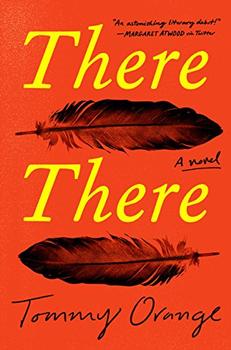
tommy orange

Like a Slide Where my Relatives are Falling

Yesterday I wrote about Little Theories about the Mass Media, and how urban legends live long after the real stories emerge.

Seems we just can’t let go of a good story, even when untrue.

Native American writers took the stage this weekend in Portland to share their stories.

One question emerged from interviewers more than once:

How do you represent yourself? As a writer, or as a Native American writer?

Tommy Orange (Cheyenne and Arapaho), whose 2018 book There There is being greeted with hearty applause, said “I always get two questions about being Native American.”

  • How much is your government check?
  • What percent Indian are you?

Indians don’t receive checks from their tribal governments, although some tribes do share gaming funds with enrolled members, sometimes called a “per capita” payment.

If they have gaming (the majority of tribes do not), resources are typically ploughed back into the community for education and infrastructure.

The U.S. government does not issue checks to individual Indians, according to the Partnership with Native Americans.

As for percentage, or blood quantum, Orange said he sees the question as a fraction.

Orange doesn’t want to be thought of as a fraction, and he avoids answering the question.

Instead he asks you to look at a fraction, like 1 over 32 or 1/32.

“When I see the slash, it looks like a slide where relatives are falling off.”

orange photo elena siebert

Tommy Orange [Photo by Elena Siebert, copyrighted]

###

TOMORROW: American Indian writers take the stage in Portland

Day 13: Native American Heritage Month

13 November 2018

#nativewriter

#nativepress

#heiderdrich

#laurada

#Layilongsoldier

#trevinobringsplenty

#literaryartsorg

#portlandlitcrawl

#wordstock

#tommyorange

#cetisawkin

#kiyuska

#nationalnativeamericanheritagemonth

#osage

#wahshashe

#whatstrending

#thebuddhaway

#deplorable

#dumptrump

Posted in nativescience | Leave a comment

Little Theories

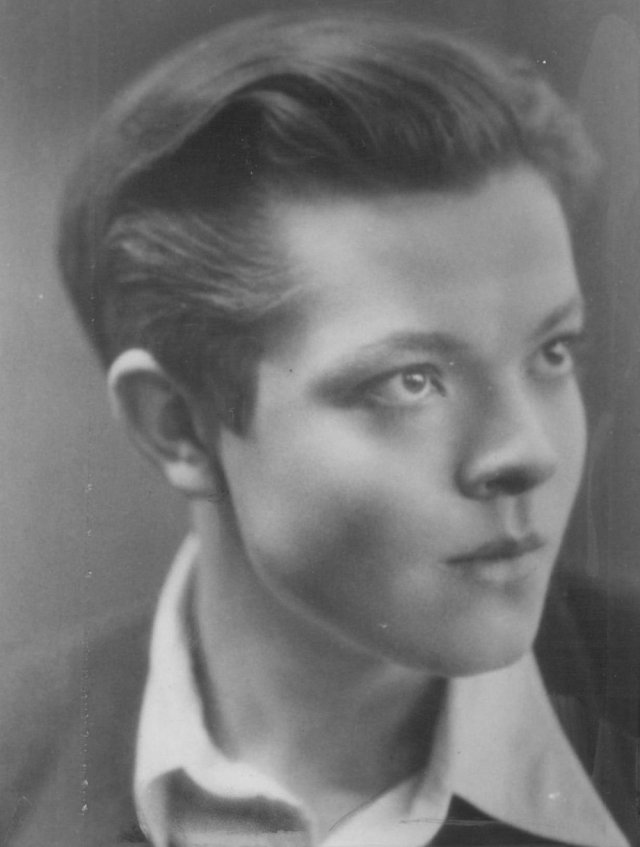
young-orson-welles-portrait-001 (1)

Orson Welles was age 23 when the War of the Worlds was broadcast in 1938

Do the Mass Media Really Influence Behavior?

Sometimes I examine Little Theories in my Blog.

I dig into ideas that we take for granted, and ask, “What is the basis for the perspective?”

For example, folks often have the perspective that mass media influence human behavior.

I call this a Little Theory.

Truth is, the mass media have only a minor influence, depending on the context, the person hearing the news, and the type of behavior you want to study.

One urban legend that still gains traction–even after 80 years–is the notion that thousands of people panicked when the Mercury Theatre broadcasted H.G. Wells’s creepy classic about Martians landing in New Jersey.

The original broadcast of War of the Worlds aired on CBS radio, the eve of Halloween: October 30, 1938.

Most of America was tuned into another program: The Chase and Sanborn Hour (a coffee company-sponsored program) which featured the ever-popular ventriloquist Edgar Bergen and his sidekick, Charlie McCarthy.

edgar-bergen_01-3

Charlie McCarthy and Edgar Bergen

Edgar Bergen was so popular that the program ran for two decades on radio, and the pair would later become regulars on a device we now call, “television.”

Folks who tuned into the Mercury Theatre in 1938 heard actor Orson Welles narrate a story that Martians had landed and were destroying New Jersey.

Most listeners knew the program was fictional, and those who weren’t sure checked other sources—they looked outside (any Martians?), they read the radio schedule in the newspaper, they checked with their neighbors, or they listened to the entire broadcast, which contained station breaks and a sign-off by Orson Welles that the program was a Halloween treat:

This is Orson Welles, ladies and gentlemen, out of character to assure you that The War of The Worlds has no further significance than as the holiday offering it was intended to be. The Mercury Theatre’s own radio version of dressing up in a sheet and jumping out of a bush and saying Boo! … That grinning, glowing, globular invader of your living room is an inhabitant of the pumpkin patch, and if your doorbell rings and nobody’s there, that was no Martian: it’s Halloween.

Folks who “panicked” were in the minority.

Had they checked other sources, they would have been reassured that—while New Jersey may strike fear in the hearts of denizens—the cause wasn’t Martians.

Still: the claim that “thousands panicked” has become a cornerstone in America’s cultural history, although the claim is false.

Just check the news around Halloween each year and you will find stories about hysteria surrounding the broadcast—which never actually occurred, according to researchers on the scene, and by historians who studied human reactions post-broadcast.

Even the respectable New York Times fell victim to the myth.

The newspaper published an opinion this month that caught my eye: the 1938 broadcast of War of the Worlds, “triggered widespread panic among thousands fearing an actual alien invasion was taking place,” according to the author.

Although the opinion-piece wasn’t about Halloween, the urban legend lives on, likely because of lazy fact-checking.

I don’t buy the fiction that news stories are “fake.”

But I do believe that reporters—and all of us–can do better by thinking more critically, and by examining the hard evidence behind our assumptions.

NOTE: Tomorrow’s blog examines such assumptions in mass media and Native American peoples.

###

Day 12: Native American Heritage Month

12 November 2018

#nativewriter

#nativepress

#charliemccarthy

#edgarbergen

#mercurytheatre

#waroftheworlds

#halloween

#hgwells

#orsonwelles

#cetisawkin

#kiyuska

#nationalnativeamericanheritagemonth

#osage

#wahshashe

#whatstrending

#thebuddhaway

#deplorable

#dumptrump


Posted in nativescience | Leave a comment

Promises Broken

Manuscript NAA MS 3912 c

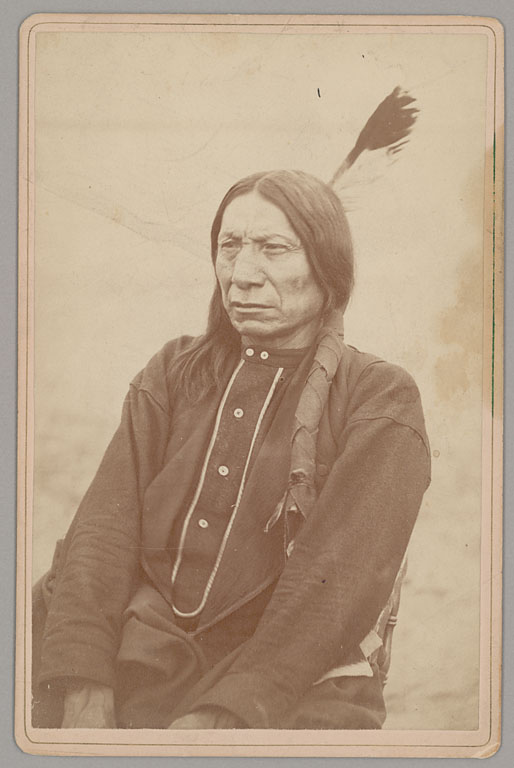
Maȟpíya Lúta (Red Cloud)

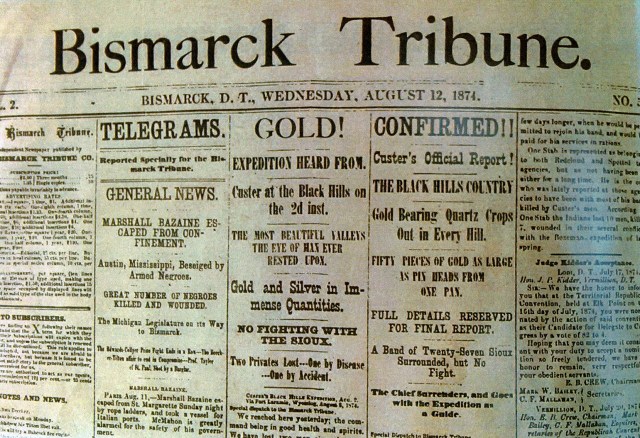
GOLD! CONFIRMED! Custer’s Official Report! Gold and Silver in Immense Quantities

November marks the 150th anniversary of the signing of the Fort Laramie Treaty (1868), which many writers suggest is the start of the end of traditional American Indian life on the plains.

The idea of the Treaty was drummed up by the U.S. government to secure peace with Native Americans and settlers.

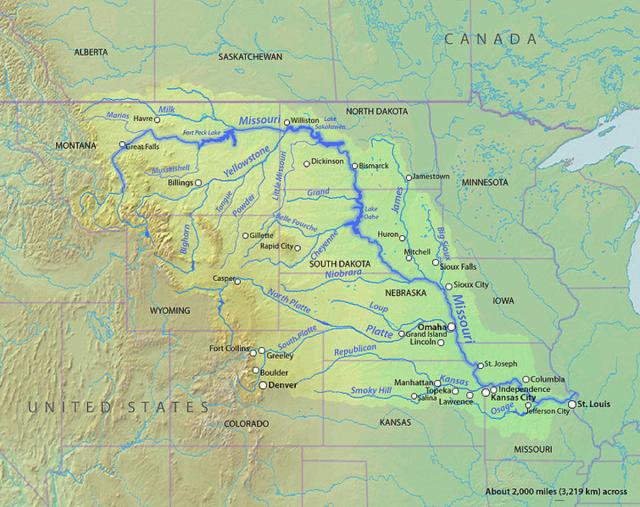
The Treaty was designed to reserve land West of the Missouri River for Native people.

The map of Indian territories is impressive: the river cuts through what are now North, South Dakota and Montana.

And the states west of the river include Wyoming, Idaho, Nebraska, Kansas, Oklahoma, Texas, Utah, Colorado, Washington, Oregon, California, Nevada, Arizona and New Mexico.
map SD

Historians write that the agreement on the Treaty was hard-won for the Sioux, especially since they insisted the sacred Black Hills would remain under Indian control.

One of the tribal leaders, Red Cloud (Maȟpíya Lúta), pushed to secure Indian advantage, according to the Dennis W. Zotigh, writing for the Smithsonian.

Red Cloud refused to sign until the U.S. Government withdrew troops from the territory.

By 1868, Red Cloud emerged as a key figure, especially for non-Indians, who saw him as fundamental to negotiations, writes Larry McMurtry in his book on Crazy Horse.

President Andrew Johnson ratified the Treaty.

It took only a few years to break the Treaty wide open.

Some Washington politicians figured too much land had been “given” to too few Indians, and in 1872, the Secretary of the Interior under the new president—Ulysses S. Grant–approved an expedition to the sacred Black Hills.

Secretary Columbus Delano wrote:

I am inclined to think that the occupation of this region of the country is not necessary to the happiness and prosperity of the Indians, and as it is supposed to be rich in minerals and lumber it is deemed important to have it freed as early as possible from Indian occupancy. I shall, therefore, not oppose any policy which looks first to a careful examination of the subject… If such an examination leads to the conclusion that country is not necessary or useful to Indians, I should then deem it advisable…to extinguish the claim of the Indians and open the territory to the occupation of the whites.

That is, Delano decided the Black Hills should be explored and, if riches were found, the territory should be open to development by non-Indians.

A 34-year-old veteran of the Civil War was assigned to lead the trek.

The veteran—a former Major General who now held the rank of Lieutenant Colonel—took the Seventh Calvary’s 1000 troops into Indian territory in the summer of 1874.

In just a few weeks, Lieutenant Colonel George Custer reported the expedition found gold, and news circulated throughout the country, alerting investors and settlers alike to the prospect of fortune-hunting in the Black Hills.

Headlines in the Bismarck (now North Dakota) newspaper announced on August 12:

GOLD!

CONFIRMED!

Custer’s Official Report!

Gold and Silver in Immense Quantities

Thousands of prospectors journeyed to the Black Hills, and Red Cloud and other Sioux leaders travelled to Washington, where the President and his staff tried to purchase the Black Hills.
Expedition08-sm (1)

The Indians refused to sell their homeland.

Over the next few years skirmishes erupted between settlers and local denizens, and the U.S. Government abandoned the Fort Laramie Treaty.

Two years after his expedition, Custer returned to Indian Country with the task of removing the Indians to government encampments.

On June, 1876, Custer and the Seventh Calvary were overwhelmed at Greasy Grass (now called Little Bighorn, Montana).

After Custer’s failure, the U.S. Government redoubled its efforts to eliminate Indian peoples.

By 1877, about two-thirds of all Sioux were driven to seek refuge at U.S. Government outposts.

That year, the government confiscated the Dakota territories in what was termed “The Agreement of 1877,” and declared ownership of the Black Hills.

The Sioux, however, refused to give up the Black Hills, and have rejected all entreaties for payment, including a Supreme Court ruling in 1980 to compensate the tribes with a $105 million payment.

The Sioux have never collected.

###

Day Eleven: Native American Heritage Month

11 November 2018

#nativewriter

#nativepress

#fortlaramietreaty

#bismarcktribune

#blackhills

#redcloud

#custer

#cetisawkin

#kiyuska

#nationalnativeamericanheritagemonth

#osage

#wahshashe

#whatstrending

#thebuddhaway

#deplorable

#dumptrump
Posted in nativescience | Leave a comment

Native Wood Carver Featured


Cherokee wood-carver Amanda Crowe

When you log onto a fresh Google page (9 November) take a look at today’s video-clip.

An animation of Cherokee artist Amanda Crowe is shown carving wood animals.

When the 50-second video ends, Google links you to online stories about Crowe.

One recent story, published in Newsweek, describes Crowe picking up a knife at age four to start carving.

Crowe was a member of a small band of Cherokee Indians who escaped the mass relocation of Natives when President Andrew Jackson sent U.S. troops to Georgia and surrounding states to remove them forcibly in the 1830s.

She spent her early years in North Carolina (where she was born in 1928) on the reserve sanctioned by the U.S. government for the Cherokee, called the Qualla Boundary (which the tribe had to buy back).

Newsweek notes that Crowe learned wood-carving from her Indatse, Goingback Chiltoskie, a renowned artist and teacher.

Although Crowe left the Qualla Boundary to study in Chicago (where she was awarded a scholarship at the Art Institute) and Mexico, she returned home to teach art.

Newsweek writes that she taught more than “2,000 students over the course of 40 years.”

###

The photo of Amanda Crowe and students is copyright-free, courtesy of the U.S. National Archives and Records Administration

Day Nine: Native American Heritage Month

9 November 2018

#amandacrowe

#goingbackchiltoskie

#cherokee

#nativewriter

#nativepress

#cetisawkin

#kiyuska

#nationalnativeamericanheritagemonth

#osage

#wahshashe

#whatstrending

#thebuddhaway

#deplorable

#dumptrump


Posted in nativescience | Leave a comment

Infusing Native Science into the Conversation

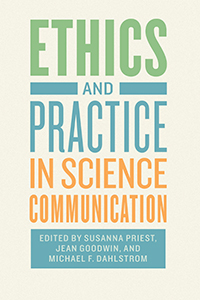
chicago book

Our book received a National award

Each November I write about Indigenous issues in honor of Native American Heritage Month.

My rationale is that we will be forgotten if we don’t remind others we are still here.

I infuse stories of Native American perspectives in my teaching, so I am happy to report that our edited book just received an award by the National Communication Association.

The book is titled, Ethics and Practice in Science Communication, and is published by the University of Chicago Press.

My contribution examines what happens when Indigenous knowledge systems confront policies that result in stealing of ancestral bones and laying waste to tribal homelands.

I argue that ethics are overlooked in favor of greed (Bears Ears) and personal self-promotion (Kennewick Man).

An alarming trend is the twisting of laws and policies that were cemented to protect Native American rights and resources.

Yet politicians and judges have allowed graves to be robbed and sacred space desecrated for mining, fracking, drilling and commercial development.

An ethical view can remind us that the resources are not yours or mine.

Resources belong to our children’s children.

We must honor generations to come.

###

Day Six: Native American Heritage Month

6 November 2018

#tommyorange

#ethicsandpracticeinscience

#universityofchicagopress

#communicationfridayblack

#nativewriter

#nativepress

#nationalnativeamericanheritagemonth

#osage

#wahshashe

#whatstrending

#thebuddhaway

#deplorable

#dumptrump
Posted in nativescience | Leave a comment

When Murders were Never Forgotten

burkart

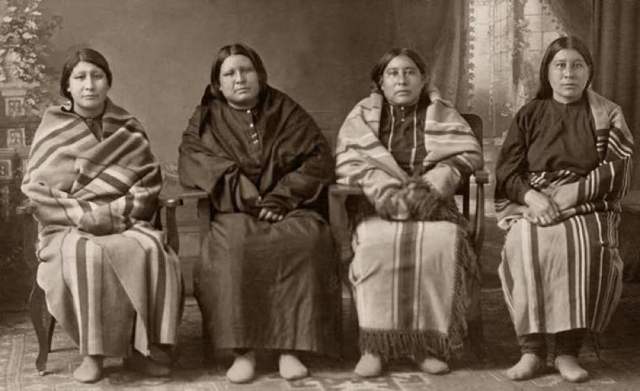
The Burkhart sisters (from left) : Rita, Anna, Mollie and Minnie

Writer Tommy Orange makes this observation:

For people of color, or for people from marginalized communities—who have long since given up on being shocked or dismayed by the news, by what this or that administration will allow, what this or that police department will excuse, who will be exonerated, what this or that fellow American is willing to let be, either by contribution or complicity.

Orange, who is Cheyenne and Arapaho and non-Native, wrote these words recently in the New York Times Review of Books about a new novel, Friday Black, that Orange refers to as:

Powerful and important and strange and beautiful collection of stories meant to be read right now, at the end of this year, as we inch ever closer to what feels like an inevitable phenomenal catastrophe or some other kind of radical change, for better or for worse.

I am not surprised that Orange, who describes himself as an urban Indian, would write that people of color have “given up on being shocked” by the news.

Today’s news reads like a tale invented by Ray Bradbury or George Orwell, where books are burned, and lies are masked as truth.

Fiction has become reality, where a para-military force we endorse with our tax dollars removes children from their parents.

We live in a nation where citizens are refused a place to vote.

Sounds like science fiction. Continue reading

Posted in nativescience | 3 Comments

My Heart Breaks a Little

1280px-1924_Indian_Citizenship_Act

Osage tribal members and President Coolidge in 1924

My heart breaks a little when I discover people won’t vote.

The disappointment comes from learning at an early age that my Native ancestors could not vote in a general election.

Although my grandmother voted in tribal elections, she said she never cast a state or U.S. ballot.

In some communities, Indians were turned away at the polling booths.

The story told in my family was that Native Americans who fought in world wars returned home only to find they weren’t considered citizens.

A landmark piece of legislation—approved by Congress and signed by President Calvin Coolidge—accorded Native Americans citizenship in 1924.

The irony is that the Fourteenth Amendment to the Constitution—which the current “president” seeks to revoke—guarantees citizenship to “any persons born in the U.S. and subject to its jurisdiction.”

Seems that the rights of American Indians were simply ignored, and even until 1957, some states barred tribal folks from voting.

So my heart breaks just a little more when I hear about citizens being denied their voting rights despite a 94-year-old law designed to allow all of us to vote.

###

Day Four: Native American Heritage Month

4 November 2018

#vote

#nativewriter

#nativepress

#NationalNativeAmericanHeritageMonth

#osage

#wahshashe

#whatstrending

#thebuddhaway

#deplorable

#dumptrump

Posted in nativescience | Leave a comment

Because You’re Special

walruscarpenter1

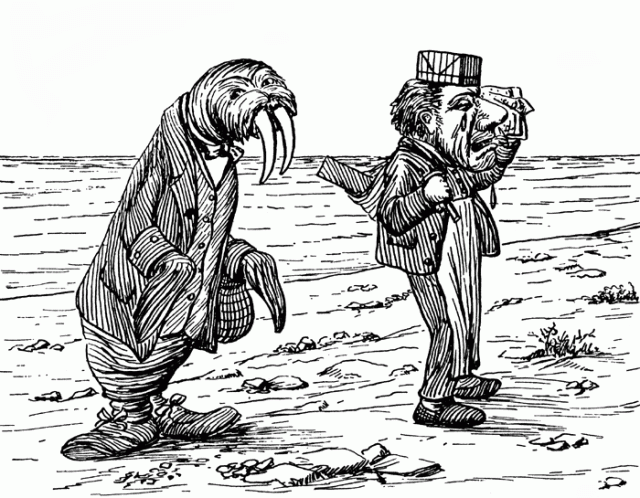
The walrus and the carpenter weep over the loss of the oysters because they ate every last one

I promised that during Native American Heritage Month (November) I would look at issues through a Native lens.

The purpose is to encourage me and to encourage readers to spend a moment considering how a story, a gesture or a song would feel through Indigenous eyes.

Today, while listening to chat-radio, I heard an Indigenous writer talk about the disjuncture of “being special” and being authentic.

The writer told the interviewer she was singled out by a grade school teacher for her creative prose at an early age.

She shared the exciting news with her mother.

But the writer’s mum just shrugged and told her daughter she wasn’t special, and that she didn’t need to please the teacher.

That’s a hard lesson: we learn that being special gives you a leg up the social ladder.

Yet, we discover a contradiction when we also learn that being special applies to everyone.

When my kids were little, they sometimes participated in sports where “everybody wins.”

On some occasions, everyone won a prize.

One of my friends told me last week that her neighbor was vacationing during Halloween.

The neighbor asked parents on the block if they would give out candy a few days earlier for her kids.

That’s because they are so special, I said.

Continue reading

Posted in nativescience | Leave a comment

What Will Kill You, and Who Cares?

Who Benefits?

IMG_2471

 Cui Bono?

That’s the question posed by writer John Gresham’s lawyer-character when confronted with a mystery she can’t solve.

She asks: Who benefits?

That’s a key question I ask students in my Propaganda class to ponder when they are being persuaded, coaxed or sold some idea.

The question is helpful when deciding on voting issues.

Some stakeholders in our state—Oregon—want to convince voters to spend less, reduce taxes and improve schools.

But if you take a look behind the curtain at who benefits from your vote, you can see special interests in play.

I try to look beyond the language and rhetoric because words can mask the meaning of a proposed piece of legislation.

You have to do your own research to understand the real issues in play because the advertising make no sense.

For example, one piece of legislation—Measure 103—uses ads driven by fear to persuade voters their grocery bills will rise unless a law is changed.

Continue reading

Posted in nativescience, votinh | Tagged , , | 4 Comments