November Welcomes Native American Heritage Month

-haZgoTdlAe58OBuwhb4b5AFoOYFzCHdMmqtgyR0dgI

But Can We Really Celebrate?

Native American Heritage Month has been officially celebrated—at least as an idea–for nearly 30 years.

The first official announcement occurred when President George Herbert Walker Bush declared November as National Native American Heritage Month in 1990.

Note that 1990 is the same year President Bush signed the landmark Native American Graves Protection and Repatriation Act (NAGPRA) to protect American Indian artifacts, objects and bones.

The 1990 law—NAGRPA—has met mixed reviews: not in theory, but in practice.

For example, the law failed to support Native American claims that a 9000-year-old skeleton should be returned to tribes.

What that means is that a federal law was enacted to help stem the tide of grave robbing and skull-collecting of Indian peoples.

The law was signed for an explicit purpose: to guarantee Indigenous bodies and artifacts would be returned their communities, tribes and relatives.

The failure of NAGPRA is documented in the case of Kennewick Man, an ancient skeleton unearthed on Indigenous lands that was declared “Caucasian.”

One solo anthropologist held a press conference after the skeleton was uncovered, declaring that the skull didn’t look like modern Indians.

So: maybe he isn’t Indigenous, the anthropologist mused.

Local tribes were not amused.

Continue reading

Posted in alternative facts, american, american indian, bears ears, Native American Heritage Month, nativescience | 2 Comments

Halloween and Native American Costumes

luckovic

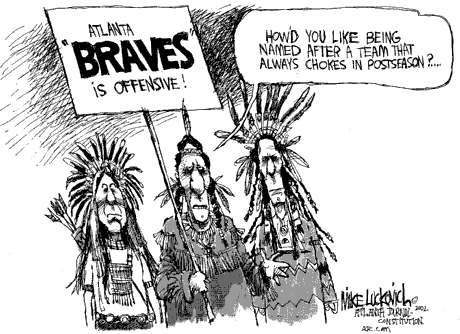
Cartoon by Mike Luckovich of the Atlanta Journal & Constitution (copyrighted)

American Indians are a diverse and heterogeneous lot.

But one thing many of us agree about is our traditional regalia.

Native regalia aren’t costumes.

Every year as Halloween approaches, I remind folks that wearing war-paint and chicken feathers is insensitive.

The clueless can buy a costume called “Indian Princess” or “Chief” on Amazon or Pinterest or eBay.

Fake outfits made in China with fake fur can still be purchased for trick-or-treaters and bar-hoppers.

Today friends have been posting photos of non-Indians dressed in fake costumes, ranging from fringed bikinis to head-dresses.

Native American activists have made some headway: muggles are more aware that the Chief Wahoo cartoon depicting the Cleveland Indians and that the Washington football team’s name (R**skins) are insulting to many Indigenous peoples.

My friend and scholar Dr. Cornel Pewewardy captures the sentiment well:

I am not your mascot, he says.

How can we better share our stories with folks who may not understand our traditions?

Maybe we should wear our regalia on Halloween.

That way, we can explain that our garments are special, historic, meaningful and sacred.

For example, it takes hours for some of us to get dressed: Sometimes an entire afternoon.

Each garment has a story, and as we tie on a legging, or smooth a ribbon shirt, we remember who wore the garment before we did and recall who stitched the fabric.

I have unpacked cedar-chests and unfolded shawls the night before an event, and spent hours re-stitching a hem or ironing a piece of ribbon.

I have watched mothers and aunties dress sons and grand-daughters to get ready for grand entry.

I have listened to fathers remind their sons how to care for bustles and fans.

And I’ve been scolded when my skirt was tied on the wrong hip, and facing the wrong direction.

Better than shaming folks who mindlessly mimic American Indian traditions.

Maybe it is more thoughtful to be pre-emptive and explain how our traditions emerged.

###

24 October 2018

#iamnotyourmascot

#cornelpewewardy

#notyourcostume

#headdress

#nativewriter

#nativepress

#osage

#wahshashe

#whatstrending

#thebuddhaway

Posted in nativescience | 2 Comments

Just another day in Portlandia

bike

On a recent bike ride to the university, one of my commuter streets was blocked to traffic.

Cyclists were steered to the sidewalk while a road crew–looking like worker-bees in their yellow, orange and black vests–loped alongside trucks and trailers.

On the sidewalk another cyclist headed toward me, so I slowed, then stopped, letting him pass.

One of the worker-bees grinned, “Hey—traffic jam!”

They waved and sang, “Have a great day,” as I cycled past.

Only in Portland, I thought—will you find a jovial road-crew.

Back on the road, I pedaled past amber-colored ash trees in the neighborhood, and thought I heard a whip.

At least, that what it sounds like when movie characters lash a crop.

I saw a bald-headed man, outfitted in a black top and black trousers, flat on his back on the sidewalk.

He was cracking a whip in the air while he lay prone.

Only in Portland.

###

20 October 2018

#onlyinportland

#Portlandia

#zenteaching

#nativewriter

#nativepress

#osage

#wahshashe

#whatstrending

#thebuddhaway


Posted in biking, nativescience, Portland | Leave a comment

When One is Enough


fig

The Story of the Lone Fig

Our potted fig tree—the third since moving to a new house—is an adolescent Lattrula fig (Ficus carica).

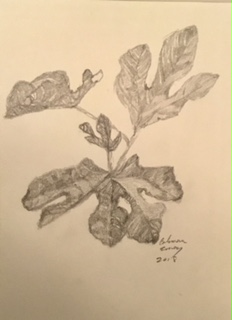
All summer we watered the fig, and I cooed at its growing leaves, which became the subject of several sketches and water-colored paintings.

Toward the end of summer the tree produced one fruit on an upper-most branch.

We checked the fig daily.

It ripened slowly, turning a rich sheen of yellow-lime, swelling delicately.

The day came at summer’s end when the fig was ready to drop from the tree, so we picked the fruit, split it, and ate it.

It was sweet, like honey, and just soft enough against your teeth.

This was the only fig our tree gave us this summer.

And it also gave us a lesson:

“When one is enough.”

###

15 October 2018

#whenoneisenough

#zenteaching

#nativewriter

#nativepress

#osage

#wahshashe

#whatstrending

#thebuddhaway


Posted in allmyrelations, garden fever, gardening, nativescience | Tagged , , | Leave a comment

Coyote Strikes

coyote


Chipping Away at Traditions we once Trusted

October is the season for Native American storytelling in Portland, where you are guaranteed to hear a tale about the trickster, Coyote.

Each story has a lesson or a moral, and in each story, Coyote’s hubris lands him in hot water.

Britons have an expression for this situation: “the fool gets hoisted by his own petard.”

The idiom refers to a revolutionary who tries to chuck a bomb, only to have it explode on himself.

Tricksters made headlines this week after sending fake academic papers to journals and having a few phony papers published.

The news stories say the three pranksters called out journals that skimp on a critical overview of manuscripts.

They chose humanities-type journals that look at gender, culture and identity studies that are sometimes mocked by empirically minded researchers

The hoaxers wrote 20 fake papers and four were published online, making their success rate about one in five—better than chance alone.

They chose humanities-type journals that look at gender, culture and identity studies that are sometimes mocked by other, empirically minded researchers.

The more I read about the hoax—in a few news articles and in the paper they published about their antics (ironically a paper in an online journal where one of the writers is the editor)—the more distress I felt.

The jokers got attention for their prank, but what did they accomplish, short of public shaming of careless editors?

While their academic colleagues are busy trying to enrich the “body of knowledge”—an honorable pursuit required for promotion, and the point of empirical studies—the trio engaged in deceit.

How are they adding to the body of knowledge?

Knowledge-making is a powerful enterprise, which is why universities require faculty to demonstrate they are active in research by publishing their work, and why academic journals carefully scrutinize research papers before they publish them.

Academic publishers in my field—like the journal where I serve as an associate editor—typically use five independent peers to carefully read and judge a manuscript: two editors, and three “blind” reviewers with expertise on the topic who don’t know who wrote the manuscript.

Missing from the news stories about the latest hoax is the wealth of worthy studies that pass muster, get published, and deepen our knowledge.

The pranksters (none of whom I know) have succeeded in one way: their mockery chips away at traditions that invite our trust.

I’m talking about institutions like universities, news outlets, hospitals, churches, pharmaceutical companies, the fire brigade and government agencies.

We place our faith in professors and reporters and doctors and priests.

  • When we swallow a pill, we trust that the contents have been tested.
  • If we’re harmed in a car crash, we trust the paramedics will take us to safety.
  • And when we breathe our air, we trust that our government takes our health to heart.

We can point to stories about incompetence and harm on the part of people we trust, and I acknowledge that some of the mistrust is earned.

The problem is that much of the chatter and clutter is stoked by fakers and fakery, resulting in lies repeated over and over.

For example, scientists agree without exception that climate change is caused in part by our own actions.

Physicians know autism isn’t caused by vaccines.

If you dig down deep enough to the roots of such stories, you’ll discover the lies are spread by tricksters who have something to gain.

Calling climate change a “hoax” is a well-trod technique used by industries and individuals that have a stake in products that harm the environment.

The fake link between vaccines and autism started when a research team published a study in 1998 that raised the issue about a supposed link, until investigators discovered that the study’s funders were bringing their own, new vaccine to market and were out to destroy the competition.

The paper was retracted and the lead writer lost his medical license.

When con-artists deceive, they end up harming folks who put their faith in firefighters and teachers and nurses.

All of us end up trusting folks and institutions a little less.

Over time, the droplet of mistrust has become an ocean of fake news and hoaxes.

And that’s a pity.

###

Free Coyote image from https://bournemouthandpoole.co/coyote-drawing/coyote-drawing-refrence-howling-coyote-drawing-free-image/

13 October 2018

#hoax

#coyote

#nativewriter

#nativepress

#osage

#wahshashe

#allmyrelations

#whatstrending


Posted in fake, nativescience, news bias | 2 Comments

The struggle against the system

Why I’m sick to my stomach

lady

Don’t you want to rail against the system sometimes?

A headline describes the feeling as “sick to my stomach.”

Problem is, the system is a web of sticky loops and traps.

Good luck changing it.

So why do some of us insist we can make a difference and change the system?

I think the sick to my stomach feeling comes from seeing harm that can (and should) be prevented.

Let’s get specific.

My relatives, and other girls and women, have been harmed by men.

The range is wide, from hurtful words to body injury.

Nearly everyone I know has–not just one anecdote–but many.

I’ve been harassed as a girl, a student and a worker-bee.

  • In high school, more than one male teacher grabbed me for a smooch.
  • As a college student working in my first internship, one employer had a policy that he’d start the day with a kiss on the lips from all the women in his circle.
  • As a professional, I had more than one co-worker placed his clothed body next to mine, insisting that I feel his stiffness.
  • And a colleague recently threatened my job when I disagreed about policy.

I’ve come to realize harassment is part of the landscape of being female.

Continue reading

Posted in kavanaugh, metoo, nativescience, Supreme Court | Leave a comment

Bruised but not beaten  

Coleman bike 2016

My steed

Truth is, I’m pretty active and coordinated (you may not believe this, after reading my blog).

My honey and I bicycle and walk, lift weights and stretch.

But we get skinned knees, loosened toenails and muscle aches.

My question: are the scrapes and cuts signs we are too active? Should we cut back?

I have a bruise the size of Africa on my right thigh.

I earned the continent-shaped injury when I fell off my bike.

At least the bike was stationary.

My bike was loaded on the right side (where I have a basket) and I was carrying home groceries.

I’ve polished my shopping skills so that I can stuff the basket to the brim and peddle home hands-free.

Problem is, I had to press the Walk Sign button in order to cross the street, and the burdened bike fell to the right, taking me with it.

The hematoma turned purple and blue, then yellow and green, and is now fading to brown.

I figured I could still wear my summer frock to a September wedding (it should cover the bruise), and as I was fussing in the mirror, I saw a bluish mark that colored my lower arm below the elbow. Continue reading

Posted in nativescience | Leave a comment

Little Theories

Who are you?

Who are you? The caterpillar asks Alice.

 Identity Politics

If I could write a book on any topic I’d explore the ways that we invent our own realities.

I will call the book, “Little Theories.”

The reason?  When I look at headlines, talk to friends, or just sit down and watch the world, I see Little Theories at work.

Some writers embrace theories.

For example, journalists have begun to incorporate language developed by scholars, such as “agenda-setting,” “framing” and “gatekeeping.”

All these terms arose from research done by my buddies in journalism scholarship.

But theories are late to bloom in everyday parlance.

I wonder if there’s a sort of “anti-theory” bias by folks who hate to be categorized as a “type.”

Alas: we are subject to foibles that befall all muggles.

For example, I read an article in the New York Times today by a reporter who writes about how we are our worst enemy when it comes to behavioral change.

The writer, Tim Herrera, says our biases prevent us from planning for the future.

The reason is that we fail to see ourselves in the future.

Instead we see Jane Doe or Juanita Diaz: not our true self.

Our Future Self sees “that other person”—a representation of our future self who’s really not …. me.

Herrera says that when researchers have folks see images of themselves (their real selves) acting in the future-tense—saving for retirement or exercising for health—we are more likely to make a behavior change.

In other words, if we see our Today Self in a Future Self activity, we make more realistic judgments.

In an era of selfies, avatars and personal brands, being more realistic about who we really seems a good idea.

But who are you? Continue reading

Posted in american, authenticity, Buddhist, framing, Fukuyama, Identity, nativescience | Tagged , , , | 2 Comments

Media Literacy in London: A round of thanks

via Media Literacy in London: A round of thanks

Posted in nativescience | Leave a comment

Is it Still Privilege if You Earn it?


community_chest_advance_to_go_card_by_jdwinkerman-d7kx1ltUnpacking the Invisible Knapsack 

I hear about privilege—particularly white privilege—but I confess: I don’t really know what people mean by privilege (spelled priviledge in Britain).

When I was a teenager my mum was strict, and we “lost our privileges” when we misbehaved.

Today a kid might be grounded, but, in my day, we were put on restriction.

And restriction means no privileges.

If this sounds penal, then you won’t be surprised to learn my mum was a deputy sheriff for Los Angeles County who worked in a women’s prison.

She was a strict parent who believed that a privilege wasn’t a right, but something you earned. Continue reading

Posted in nativescience, white privilege | Leave a comment