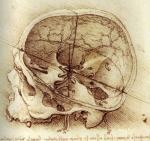
Rendering by Leonardo Da Vinci
Consider the mind, rather than the brain.
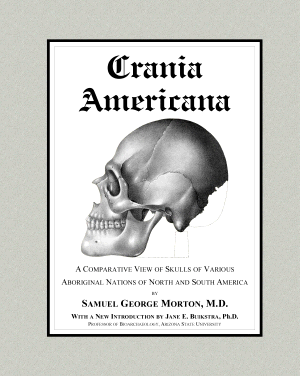
I asked readers in the last blog to think about the mind rather than the brain because Samuel Morton’s skull measurements in the 1860s asserted that American Indians have smaller skulls, hence smaller brains.
In other words, American Indian brains were inferior.
Today some folks think that bigger brains mean smarter people. Not true, say neuroscientists.
But average folks—like you and me—cling to beliefs dismissed by scientists.
For example, most neuroscientists reject the notion that we use only 10% of our brain.
A 2002 study reported that 6% of the scientists agree we use only a fraction of our brain, compared to about 59% of college graduates who think we use just 10% of our brain.
And folks who read newspapers were even more likely to accept the myth: 67% of newspaper readers said we use 10% of our brain.
We tend to think of the brain as a computer: 80% of lay publics said the brain “works like a computer.”
But only 47% of scientists likened the brain to a computer.
Still, scientists consider the mind to be a reflection of the brain: 91% agree. And only 3% said the spirit or soul is involved.
Lay folk think of the mind quite differently: at least one-third think the spirit or soul is involved in the mind.
So: do you separate mind from brain? How?
[See Houzel, 2002, Do you know your brain, Neuroscientist, (8; 98)]








 Cynthia (Ištá Tȟó Tȟó) Coleman Emery's Blog