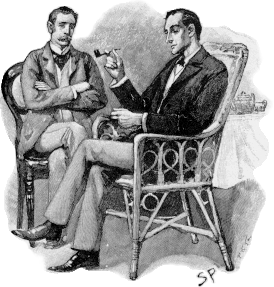
Watson and Holmes
Question assumptions.
Just like Sherlock Holmes, whose exploits are finding new audiences in 2013, we should look beyond the surface. Continue reading

Watson and Holmes
Question assumptions.
Just like Sherlock Holmes, whose exploits are finding new audiences in 2013, we should look beyond the surface. Continue reading
 There’s a delicate balance between teaching and learning; between giving instruction and taking over the task.
And it takes a nimble soul to figure out when to let someone falter or fail.
A student sent an email recently to make an appointment and I set the date we agreed upon. Continue reading
 When I read about machines that can learn, my mind flew from science to science fiction.
Can machines really learn?
I always thought that’s what they meant by intelligent design–that machines were programmed to respond intelligently to new stimuli. Continue reading
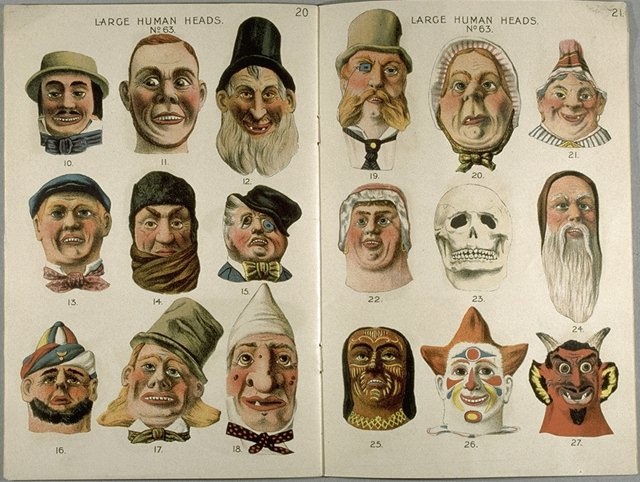 The conversation turned to race.
My talk Wednesday at the Newberry focussed on Native and scientific perspectives, particularly over Kennewick Man–the 9300-year-old skeleton discovered in the Columbia River.
During the question and answer session one guest asked if Kennewick Man fuels the conversation over race. Continue reading
 One life-changing moment arrived when my poor grades in science resulted in a letter home to my parents.
As I confessed in a post penned weeks ago, my parents waved away my argument that girls don’t need science or math.
My choices were to continue down a sullen spiral of teenage bitterness (“That will show them”) or make a 180-degree turn and start engaging.
One day in science class I glanced up from the note I was scribbling to a friend and looked at Cheryl, the smartest kid in class. Continue reading
 My days are full of epiphanies and ah-hah moments, often because I learn something new and I’m piqued.
Sometimes the epiphany arrives like the UPS delivery chap who knocks on the wrong door.
Like the package I can’t keep, the epiphany is one where I learn I’m wrong about something.
Sometimes our mistakes make us better teachers. Continue reading
 Imagine you could cure a disease but the government refused to allow you to study the data.
That’s what happened at the US Centers for Disease Control and Prevention (CDC) according to the latest issue of Scientific American.
The CDC hires scientists and doctors to study a range of issues from flesh-eating bacteria to tuberculosis, and staff gather evidence on what harms you—morbidity—and what kills you—mortality. Continue reading
 Received a thoughtful comment from a reader about the mixed messages we receive in light of Nike’s campaign to promote Oscar Pistorius as a weapon, warrior and “bullet in the chamber.”
The campaign hit a concrete wall when Pistorius’ girlfriend was found dead after he allegedly discharged a weapon 4 times in the bathroom where she had retreated. Continue reading
 Some poor sod is having a bad PR day.
Turns out Nike’s advertising campaign featuring Oscar Pistorius likens the athlete to a bullet in the chamber.
Problem is Pistorius has been accused of releasing four real bullets from the chamber of a 9 mm pistol and killing his girlfriend.
You can’t escape news of the Valentine’s Day shooting that left Reeva Steenkamp dead.
And it’s not just fodder for the tabloid media: mainstream news have reports daily about the shooting, rife with speculation about Pistorius, who grabbed headlines as a Paralympian and Olympian who runs with aid of blade-like prosthetics. Continue reading
Cosmo Kramer
I admit to being a smidge off-center.
Like the Seinfeld episode when Kramer’s living room transforms into the Merv Griffin set, I imagine my couch welcomes guests who chat about their cats and cars. Continue reading


 Cynthia (Ištá Tȟó Tȟó) Coleman Emery's Blog