Feeling Rotten, Part 2 Yup: the lies, the venom, the cronyism and the bigotry repulse me. We have buried integrity in the political landscape. Two examples of integrity loom: one made headlines thi…
Source: Bring Back Integrity

Feeling Rotten, Part 2 Yup: the lies, the venom, the cronyism and the bigotry repulse me. We have buried integrity in the political landscape. Two examples of integrity loom: one made headlines thi…
Source: Bring Back Integrity
Feeling Rotten, Part 2
Yup: the lies, the venom, the cronyism and the bigotry repulse me.
We have buried integrity in the political landscape.
Two examples of integrity loom: one made headlines this week, and the other may be hidden from your view.
Let me explain.
Integrity means an integrated whole, free from corruption; it means honesty; and it means virtue as it relates to truth, fair dealing and uprightness, according to the Oxford English Dictionary.
So it is no surprise that integrity was eclipsed by corruption when elected Republicans met in secret Monday evening this week (on January 2: a federal holiday)—before government officially opened for business Tuesday—and they voted to gut the powers of the ethics office without any prior announcement or publicly available agenda.
The Washington Post reported that a group of Republicans voted to strip the powers of the Office of Congressional Ethics—which works independently to investigate violations of integrity—and place the Office under the control of the House Ethics Committee.
Ovem lupo committerre, as the saying goes.
Don’t let the wolf guard the sheep.
Why does this action cause concern?
As new leadership is poised to take hold in Washington, some elected officials decided integrity, honesty, virtue, truth, fair dealing and uprightness aren’t important.
Elected officials who agreed to gut the ethics office included folks whose behaviors had been questioned: a Texas Congressman investigated for sexual harassment; a Representative from Illinois who took an overseas trip paid “improperly” by the Taiwanese government; a Missouri lawmaker who called in “friendly” expert testimony on a project in which he has a financial stake; and a New Mexico legislator whose staff member was investigated by the ethics office, according to The New York Times.
In less than 24 hours–without warning–the Republicans backed down after being “Deluged by angry phone calls and bad headlines,” according to the Times.
“Thousands of phone calls flooded lawmakers’ offices and both conservative and liberal ethics groups issued statements condemning the vote,” The Times reported.
“Republican officials say they were well on their way to abandoning the ethics revisions” when the president-elect tweeted that Republicans should “focus instead on taxes and health care.”
Too late.
The president-elect didn’t reverse the decision.
You did.
Public outcry forced the issue.
See: you can make a difference.
But pay heed: government isn’t totally corrupt.
Corruption occurs, whether or not vigilance prevails.
* * *
This week I was reading through government mission statements for a research project and, much to my delight, I found integrity in full force.
One of our country’s Cabinet-level areas—a Department headed by an individual appointed by the US President and confirmed by the Senate—outlines ethical standards in black-and-white:
Key to maintaining public trust and confidence in the integrity of government is the adherence of high ethical standards and ensuring that government business is conducted with impartiality and integrity.
I rallied from my funk: High ethical standards, impartiality and integrity. From government.
That means the Department embraces moral principles and adheres to practices that are free from bias and corruption, according to definitions from the Oxford English Dictionary.
In addition, the federal Department:
Follows the law and holds people accountable. Accountability is a key theme: The Department expects to be held accountable [and] does not tolerate lapses that detract and distract from good, honest service to the American people.
Accountability means you are responsible for your conduct and must answer to American publics.
I interpret this phrase to mean that our nation’s Cabinet members and their staff are honest—which is to say—truthful.
I expect Cabinet members to fully disclose their activities, including their tax returns and financial interests.
Financial interests are key for two reasons.
The first reason is the clue that any sleuth worth her salt knows to be true: Follow the money.
When crucial decisions are made at the highest level of governance, and on behalf of all Americans, we need to ask: cui bono?
Who benefits?
The president-elect’s Cabinet choices thus far are the richest white folks (nearly all men) ever picked, according to Slate.
Without exaggeration, the millionaires and billionaires break “historical precedent,” Slate claims.
And yet, a promise was made to American publics that the Tangerine Twit would “strike against the elite and special interests that have wielded disproportionate power and influence in American politics and society.”
Instead, the promise was broken: a sign of ruptured integrity.
Elite and special interests are being tapped to run the country.
The proposed Cabinet “looks almost exactly like the modern Republican Party: older, white, anti-government, and extremely conservative on virtually every issue,” writes The New Yorker.
I turn to the last phrases contained in the Ethical Standards treatise, which says that Cabinet decisions are:
Based on sound science and the best interest of the public. The Department promotes and supports transparency, accountability and efficiency.
Sound science means that experts knowledgeable about facts based on evidence—not beliefs that arise from opinion or special agendas—agree on truths:
Understanding data isn’t our strong suit, if we look at rankings of 15-year-old students in our country.
The United States ranks far below industrialized and so-called “second-world” (socialist or communist) countries in 29th place out of 76 countries for math and science scores.
That’s like scoring 62 percent out of 100 on an exam.
We’re in the 38th percentile.
In concrete terms, our grade is an F.
Leading the pack of top grade-earners are Singapore, Hong Kong, South Korea, Japan and Taiwan.
European front-runners include Finland, Switzerland, The Netherlands and Germany.
Our Canadian neighbors out-rank us in tenth place.
###
5 January 2016
Postscript:
Tomorrow I look at the role of science in decision-making.
We are leagues behind developed and developing countries in terms of our childrens’ understanding of math and science.
We deserve a grade of F on our math and science scores compared to other countries.
My treatise is that our collective decisions to promote “truthiness” rather than truth makes us vulnerable to poor decisions.
By promoting gut beliefs over rational facts, we delude ourselves.
Truthiness, by definition, means we glean our truths from “what feels right.”
It’s not truth-truth. It’s felt-truth. Belief-truth.
Problem is, our gut feelings are prone to a colorful assortment of beliefs bereft of fact.
When we bow under the weight of our felt-beliefs, we lose our perspective.
Felt-belief is emotion.
Fact-belief is rationality.
And somewhere along the lines of debate, emotion rules.
Stay tuned.
Artwork from http://complianceandethics.org/3973-2/
#Nativescience
#tangerinetwit
#ethics
#cynthialcoleman
#dtw
#nativescience
#republicans
#watchdog
Feeling Rotten, Part 1 You could probably write the New Year’s tips in your sleep. First, there’s the worst-and-best-of lists: Best movies Worst Twitter quotes Best albums Worst-dressed hip hop art…
Feeling Rotten, Part 1

Image by Mike Luckovich of the Atlanta Journal-Constitution
You could probably write the New Year’s tips in your sleep.
First, there’s the worst-and-best-of lists:
Then there’s the concoction of clips of actors who died, celebrities who divorced, and top dogs who won first place in beauty contests.
There are the hang-over cures, how-to-ask-your-boss-for-a-raise advice, and diet tips.
This year, wordsmiths want to pluck us from our blue-tinged haze of the “worst year ever” and get on with life.
But I’m feeling rotten and I’m not ready to leave my despair behind.
Besides: the Best-Worst lists and diet diatribes mean that we are—once again—distracted from the hostile animus gripping our nation.
We’re more interested in Brad and Angela’s parting shots than the shots that murdered 39 innocent souls in Istanbul this week.
I don’t want to “get on” when misogyny and racism beckon. Continue reading

How we’re losing our true freedoms
I’ve been sitting on the fence for so long when it comes to women’s undergarments that my derrière is numb.
So today’s New York Times story about knickers made by women for women without a hint of consent from the male persona feels like feminist heaven.
Feminist vernacular has been seized in service to marketing ploys where women are sold girdles to give them control over their destinies, as Andi Zeisler notes in We Were Feminists Once.
Zeisler offers a critique of advertising that uses feminist ideology to sell stuff:
Lacy underpants empower you.
Push-up bras promote confidence.
Stiletto heels heighten your gravitas.

Remain vigilant
Sunday—a day punctuated by football games and family dinners—is a poor timing choice for breaking important news, but the US Army Corps of Engineers announced today it “would not approve permits for construction of the Dakota Access Pipeline beneath a dammed section of the Missouri River that tribes say sits near sacred burial sites,” according to The New York Times.
The Times sent me a text this afternoon—Pacific Coast Time—that authorities need to “explore alternate routes for the pipeline crossing.”
The decision comes at the eleventh hour, when tribes face a deadline Monday—tomorrow—to vacate the encampment where activists have protested construction of the pipeline, designed to span more than 1000 miles and deliver crude oil to North Americans.
Here in Portland, Oregon, protest rallies have been planned for tomorrow—Monday—to coincide with the deadline given the tribes to leave the encampment.
So: what happens next?
Many will see the announcement as a victory for indigenous peoples.
But key issues remain unresolved. Continue reading
 When Paralysis Takes Hold
I am filled with dread as November comes to a close.
November should have been cause for celebration: Hillary Clinton won the popular vote by a substantial margin and American Indians brought attention to craven injustices surrounding citizens’ water and land use.
And November honors Indians with National Native American Heritage Month: one attempt to recognize that we have not vanished.
We are still here.
At last count, seven thousand activists are “hunkered down” in the frigid cold of North Dakota, according to the New York Times.
Activists hope to prevent construction of a 1,300-mile pipeline destined to channel crude oil across several states in North America.
And across Indian homelands usurped by the federal government, who then sold off parcels to settlers and investors in the 19th century.
Anyone with cash could buy property—anyone except American Indians, who were forbidden from buying back their lands.
Why? Continue reading
& The Last of the Mohicans
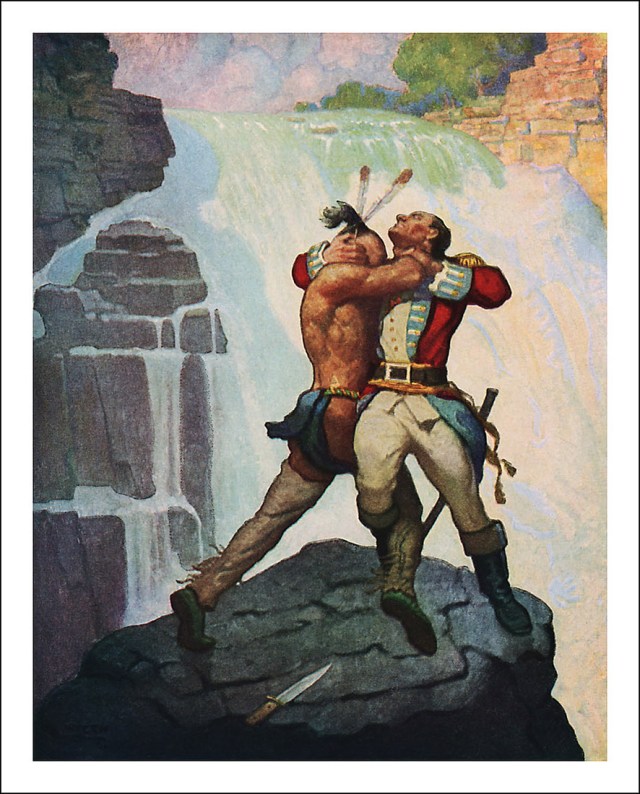
N.C. Wyeth’s illustration of Last of the Mohicans
How did my wedding anniversary become embroiled in the Leatherstocking Tales?
How does my husband conjure up James Fenimore Cooper’s The Last of the Mohicans?
My story is innocent.
I swear.
Readers may remember that I pledge every November to write about life through the lens of indigeneity.
Today the Indian narrative crept in without effort.
Our wedding anniversary falls in November—same as National Native American Heritage Month—two events that are purely coincidental.
While my heritage is French, American Indian (Osage and Sioux), and British, my husband’s ancestry is British and Russian Jew. Continue reading
Today’s New York Times Editorial

New York Times photo of Phil Little Thunder Sr. Photo by Alyssa Schukar for The New York Times
A major shift in news coverage occurred this summer as citizens gathered in North Dakota to protest construction of a 1,134-mile oil pipeline.
And, for once, mainstream news media witnessed and reported on the events.
While non-Indian media have failed to attend to critical issues from an Indian perspective—favoring scientists over culture over the bones of Kennewick Man and cheering on businesses that dig copper, silver and gold mines on sacred lands—the proposed pipeline drew media in droves.
And today, November 4, 2106, during National Native American Heritage Month, the New York Times editorial board states:
It’s time to move the pipeline.
The decision about where to place the pipeline plays out like a case study in society’s prejudices.
The pipeline—which will run through four states in North America and deliver crude oil—was scheduled to be built near North Dakota’s capital, Bismarck.
The Times reports that the pipeline was rerouted because regulators saw a “potential threat to the city’s water supply.”
Instead the pipeline is now slated to run through Indian territory, close to Sioux land (less than a half-mile from one reservation) and “under the Missouri River,” which provides drinking water to residents.
And the Indians are standing up to government agencies and private business interests that made decisions favoring the denizens Bismarck over the indigenous people of North Dakota.
The Times editorial notes construction of the crude oil pipeline is one among a boatload of decisions impacting indigenous people, who “pay the price for white people who want to move environmental hazards out of sight, out of mind and out of their water faucets.”
Now is the time for a “meaningful discussion of the pipeline’s merits,” the editorial notes.
About time indeed.
Photo credit: Phil Little Thunder Sr., from the Rosebud reservation in South Dakota, carries water from his hometown for the sacred ceremony to the burial ground in North Dakota. Alyssa Schukar for The New York Times
Celebrating National Native American Heritage Month
#pipeline
#Nativescience
# Nationalamericanheritagemonth
National American Heritage Month

Osage relatives
November comes on the heels of several events that focus attention on North American Indians.
That’s good news. And bad news.
The good news is that the spotlight reminds us that critical, life-changing events impact American Indians now. Today.
Bad news is that the more frivolous—but still important—issues make headlines that distract us from core issues.
November ushers in National American Heritage Month, a time when I shift my gaze through the prism and examine life through a Native lens.
The exercise began in 2010 when I started my blog while serving as a fellow at the National Museum of the American Indian in Washington, DC. Continue reading


 Cynthia (Ištá Tȟó Tȟó) Coleman Emery's Blog